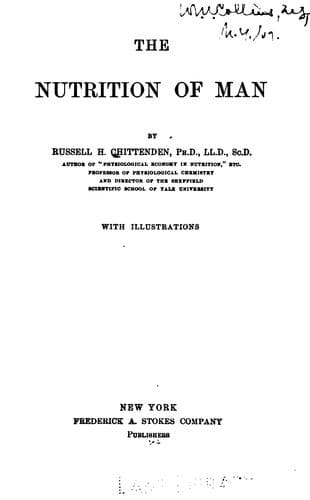
The nutrition of manChittenden, R. H. (Russell Henry)
Science
The nutrition of man
Chittenden, R. H. (Russell Henry)
Nutrition
With maintenance of body-weight, together with nitrogen equilibrium
through all these months; and with health, strength, and mental and
physical vigor unimpaired, there is certainly ground for the belief
that the real needs of the body were as fully met by the lowered
consumption of proteid food as by the quantities called for by the
customary standards. Finally, it should be noted that this particular
subject was small in weight, and hence did not need so much proteid
as a man of heavier body-weight would require. In recognizing this
principle, we may for future comparison calculate the nitrogen
requirement of the body, on the basis of the present results, per kilo
of body-weight. With the weight of the subject placed at 57 kilos, and
with an average daily excretion of nitrogen amounting to practically
5.7 grams, it is plain that this individual was quite able to maintain
a condition of equilibrium with a metabolism of 0.1 gram of nitrogen
per kilo of body-weight. Translated into terms of proteid matter, this
would mean a utilization by the body of 0.625 gram of proteid daily
per kilo of body-weight. Regarding the fuel value of the daily food,
we need not be more precise than to emphasize the fact that so far as
could be determined, on the basis of chemical composition, the heat
value of the food rarely exceeded 1900 calories per day. If we make a
liberal allowance, for the sake of precaution, it would seem quite safe
to say that this particular individual, under the conditions of life
and bodily activity prevailing, did not apparently need of fuel value
more than 2000 calories per day, which would correspond to 35 calories
per kilo of body-weight.
Let us turn now to the second subject in this group, a man of 76 kilos
body-weight, 32 years of age, and of strong physique. His active life
in the laboratory called for greater physical exertion than the former
subject, and consequently there was need for greater consumption of
non-nitrogenous food, with the accompanying increase in fuel value of
the day’s ration. As in the preceding case, there was no prescribing
of food, but a gradual and voluntary diminution of proteid material.
During the last seven months and a half of the experiment, the average
daily excretion of nitrogen through the kidneys amounted to 6.53 grams,
equivalent to a metabolism of 40.8 grams of proteid matter daily; a
little more than one-third the minimal quantity called for by common
usage. At first, the body-weight of the subject gradually fell until it
reached 70 kilos, at which point it remained fairly constant during the
last five months. That the quantity of food taken was quite sufficient
to maintain the body in a condition of nitrogen equilibrium is apparent
from the results of a comparison of income and outgo of nitrogen, as
shown in the following table:
Public-domain text, read in full here on John Shaqi.
Reviews
Reviews
No reviews yet
Be the first to share your thoughts on this work.
Elsewhere in the archive
Join the Discussion
Join the discussion
Sign in to leave a comment or review.
Sign InorCreate an account