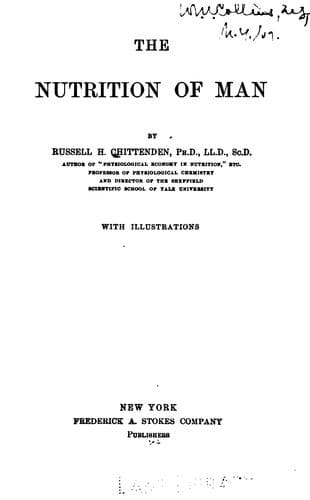
The nutrition of manChittenden, R. H. (Russell Henry)
Science
The nutrition of man
Chittenden, R. H. (Russell Henry)
Nutrition
Without exception, we note with all of the men a phenomenal gain in
strength, which demands explanation. Was it all due to the change in
diet? Probably not, for these men at the beginning of the experiment
were untrained, and it is not to be assumed that months of practical
work in the gymnasium would not result in a certain amount of physical
development, with corresponding gain in muscular skill and power.
Putting this question aside for the moment, however, it is surely
proper to emphasize this fact; viz., that although the men for a
period of five months were restricted to a daily diet containing
only one-third to one-half the amount of proteid food they had been
accustomed to, there was no loss of physical strength; no indication
of any physical deterioration that could be detected. In other words,
the men were certainly not being weakened by the lowered intake of
proteid food. This is in harmony with the principle, already discussed,
that the energy of muscle work comes primarily from the breaking down
of non-nitrogenous material, and consequently a diminished intake of
proteid food can have no inhibitory effect, provided, of course, there
is an adequate amount of proteid ingested to satisfy the endogenous
requirements of the tissues.
On the other hand, recalling the large number of nitrogenous cleavage
products which result from the breaking down of proteid material, we
can conceive of an exaggerated exogenous proteid katabolism which
may flood the tissues and the surrounding lymph with a variety of
nitrogenous waste products, having an inhibitory effect upon the
muscle fibres themselves, or upon the peripheral endings of the motor
nerves, by which the muscles are prevented, directly or indirectly,
from working at their highest degree of efficiency. This being true,
a reduction of the exogenous katabolism to a level more nearly
commensurate with the real needs of the body might result in a marked
increase in the functional power of the tissue. However this may
be, the fact remains that all of the subjects showed this great
gain in strength; and furthermore, there was a noticeable gain in
self-reliance and courage in their athletic work, both of which are
likewise indicative of an improved condition of the body. How far these
improvements are attributable to training and to the more regular life
the men were leading, and how far to the change in diet, cannot be
definitely determined. We may venture the opinion, however, for reasons
to be made clear shortly, that the change in diet was in a measure
at least responsible for the increased efficiency. As the writer has
already expressed it, there must be enough food to make good the
daily waste of tissue, enough food to furnish the energy of muscular
contraction, but any surplus over and above what is necessary to supply
these needs is not only a waste, but may prove an incubus, retarding
the smooth working of the machinery and detracting from the power of
the organism to do its best work.
Public-domain text, read in full here on John Shaqi.
Reviews
Reviews
No reviews yet
Be the first to share your thoughts on this work.
Elsewhere in the archive
Join the Discussion
Join the discussion
Sign in to leave a comment or review.
Sign InorCreate an account