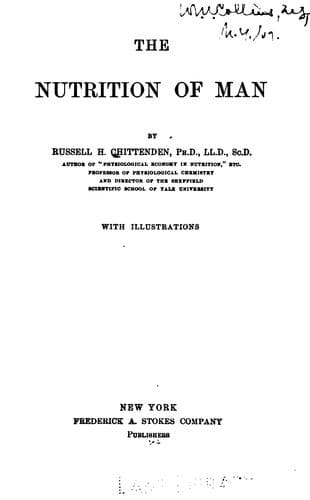
The nutrition of manChittenden, R. H. (Russell Henry)
Science
The nutrition of man
Chittenden, R. H. (Russell Henry)
Nutrition
Recently, Professor Irving Fisher,[63] of Yale, has conducted an
interesting experiment on the influence of a change in diet on
endurance, having the co-operation of nine healthy students as
subjects. The experiment extended through five months, with endurance
tests at the beginning, middle, and end of the period. At the outset,
the men consumed daily an average of 2830 calories, of which 210
were in the form of flesh foods, such as meats, poultry, fish and
shell-fish; 2.6 calories of proteid being ingested for each pound of
body-weight. At the close of the experiment, the per capita calories
had fallen to 2220, of which only 30 were in flesh foods, and the
proteid had fallen to 1.4 calories per pound of body-weight. In other
words, the total calories of the daily ration had dropped off about 25
per cent, the proteid about 40 per cent, and the flesh foods over 80
per cent, or to about one-sixth of their original amount.
[63] Through the kindness of Professor Fisher, the writer has had the
opportunity of reading the report of this work, which at this writing
is not published, and he has drawn upon it freely for the following
statements of fact.
To determine the endurance of the subjects, six simple gymnastic
tests were employed, and one of mental endurance. The physical tests
consisted of (1) in rising on the toes as often as possible; (2) deep
knee-bending, or stooping as far as possible and rising to the standing
posture, repeating as often as possible; (3) while lying on the back,
raising the legs from the floor to a vertical position and lowering
them again, repeating to the point of physical exhaustion; (4) raising
a 5-lb. dumb-bell (with the triceps) in each hand from the shoulder up
to the highest point above the head, repeating to the point of physical
exhaustion; (5) holding the arms from the sides horizontally for as
long a time as possible; (6) raising a dumb-bell (with the biceps) in
one hand from a position in which the arm hangs free, to the shoulder
and back, repeating to the point of physical exhaustion. This test was
taken with four successive dumb-bells of decreasing weight, viz., 50,
25, 10, and 5 pounds respectively. The mental test consisted in adding
specified columns of figures as rapidly as possible, the object being
to find out whether the rapidity of performing such work tended to
improve during the experiment.
The following table shows the results of the three sets of physical
tests made in January, March, and June:
TESTS OF PHYSICAL ENDURANCE WITH THE NINE SUBJECTS
Public-domain text, read in full here on John Shaqi.
Reviews
Reviews
No reviews yet
Be the first to share your thoughts on this work.
Elsewhere in the archive
Join the Discussion
Join the discussion
Sign in to leave a comment or review.
Sign InorCreate an account