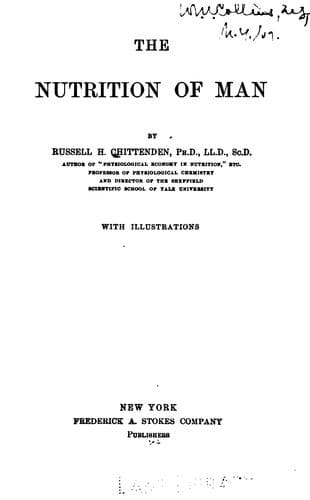
The nutrition of manChittenden, R. H. (Russell Henry)
Science
The nutrition of man
Chittenden, R. H. (Russell Henry)
Nutrition
The data presented show a marked improvement in March and June over the
record made at the beginning of the experiment in January, except in
the case of one subject, E. As Fisher states, the increased endurance
observed can be ascribed only to dietetic causes, since no other
factors of known significance could have aided in the result. The
dietetic changes, as we have seen, consisted in a slight reduction of
the total amount of food consumed daily, but with a large reduction of
the proteid element, especially from flesh foods. It is significant,
says Fisher, that the only man whose strength and endurance showed any
decrease was E, “whose case was exceptional in almost all respects.
His reduction in quantity of food, except for a spurt at the end, was
less than of most of the men; his reduction in proteid, with the same
exception, was the least of all; his reduction in quantity of flesh
foods was the least of all.” He stands out conspicuously as the one man
whose endurance failed to improve. The mental test carried out with the
subjects pointed to “a slight increase in mental quickness,” but the
adding test was too short to be of great value.
We see in these results another confirmation of the view that the
welfare of the body is not impaired by a marked reduction in the amount
of proteid food; on the contrary, benefit results in the increased
efficiency which manifests itself in various directions. Physical
endurance is an asset not to be ignored, and like the strength of an
individual, it may well be fostered by the recognition and practice of
a principle which seemingly has a firm physiological basis. Whether
the fatigue poisons come from the excessive exogenous katabolism of
proteids in general, or whether they are derived directly in a measure
from flesh foods, need not be considered here; the main point is that
by lowering the rate of proteid katabolism, which necessarily compels a
reduction in the amount of flesh foods, there is a diminished quantity
of nitrogenous waste floating about in the body. Further, we need
not criticise too closely the method by which the reduction of food
is accomplished; whether it be by encouraging mastication, with a
view to better tasting and fuller enjoyment of the food, to the point
of involuntary swallowing; or whether we follow natural taste and
appetite, reinforced by the use of reason, with a full appreciation
of the principle that the welfare of the body is best subserved by a
quantity of food commensurate with true physiological needs.
Public-domain text, read in full here on John Shaqi.
Reviews
Reviews
No reviews yet
Be the first to share your thoughts on this work.
Elsewhere in the archive
Join the Discussion
Join the discussion
Sign in to leave a comment or review.
Sign InorCreate an account