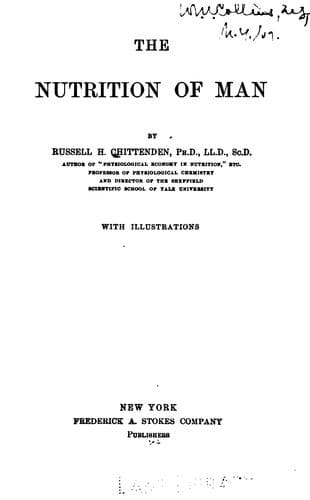
The nutrition of manChittenden, R. H. (Russell Henry)
Science
The nutrition of man
Chittenden, R. H. (Russell Henry)
Nutrition
In making this presentation of the true food requirements of the
body as based on the results of physiological experimentation and
observation, I am by no means unmindful of the dangers of underfeeding;
but this is a condition comparatively rare. When occurring, as stated
by Dr. Curtis, “it is either because of dyspepsia, in which case it
really is involuntary, or comes from some silly notion born of a
combination of innate mental crookedness and that ‘little knowledge’
that is a dangerous thing.” Overfeeding is the predominant dietetic
sin, and with the prevailing dietary standards, as fixed by common
usage, there is good ground for believing that it will continue for
many years to come. Reason tells us, however, in the practice of our
personal nutrition, to steer a middle course between physiological
excess on the one side, and the minimal food requirement on the other.
To quote again from Dr. Curtis,[64] who has expressed the matter very
forcibly, “The physiological chemist can easily draw a line on the
Scylla (starvation) side of the channel. A dietary whereby the system
gets less than it pays out is, obviously, a dangerous veer toward
starvation rock. But on the Charybdis (stuffing) side, just as the
whirlpool itself has no well-defined border, the channel boundary is
not so easily marked. The case is exactly analogous to the stoking of
a furnace. The proportion of ash to live coals is a telltale as to
_under_feeding, but not as to _over_feeding. With undersupply of fuel
the ashes overbalance the live coals, and the fire is thus foretold to
be going out. But with an oversupply the fire simply burns the faster:
all the fuel continues to be consumed; the more coal simply makes the
more ash, so that equilibrium is not disturbed, although maintained
at a higher level. To argue, therefore, that a given dietary is none
too large, because the balance between the material receipts and
expenditures of the economy is not upset, would be like saying that a
given furnace-fire is certainly none too hot, since the ashes raked
out of the fire-box just correspond to the amount of coal shovelled
in. The same would be equally true of a slower fire consuming much
less fuel. The philosophy of the matter is, then, to find the minimum
of steam that will run the engine, and then maintain a fire somewhat
hotter than the exact requirement, in order to run no risk of failure;
or, to return to the metaphor already employed, the would-be careful
liver must simply note how close to Scylla other voyagers have sailed
with safety, and then steer his own bark accordingly.”
[64] Edward Curtis, M. D.: Nature and Health. New York, Henry Holt &
Co. 1906. p. 71.
Public-domain text, read in full here on John Shaqi.
Reviews
Reviews
No reviews yet
Be the first to share your thoughts on this work.
Elsewhere in the archive
Join the Discussion
Join the discussion
Sign in to leave a comment or review.
Sign InorCreate an account