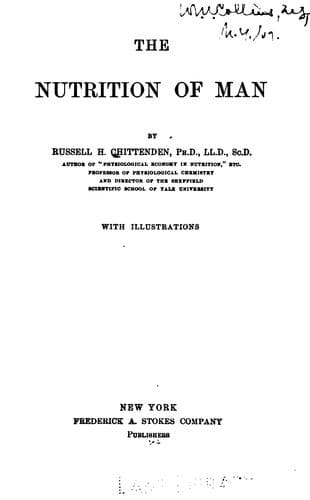
The nutrition of manChittenden, R. H. (Russell Henry)
Science
The nutrition of man
Chittenden, R. H. (Russell Henry)
Nutrition
Probably, one of the chief reasons why persistent efforts were made
to improve the dietary of the navy was the prevalence among the men
of the disease known as beriberi. “While no satisfactory explanation
as to the cause of the disease was offered, it was generally believed
that there was some very close relation between the disease and the
rice diet” (Oshima). During the years 1878–1883 inclusive, nearly 33
per cent of the marines suffered from beriberi. With the adoption of
the new ration in 1884, in which a large part of the rice was replaced
by bread and other articles, and with better hygienic conditions,
this disease immediately began to disappear, and during the six years
after the adoption of the new diet only 16 per cent of the marines
were affected by the disease. Later on, hardly more than two or three
cases a year were recorded. Advocates of a high proteid diet bring
forward this illustration as an evidence of the danger connected with
a lowered proteid intake; _i. e._, that the nutrition of the body
will be impaired and diseases of various sorts liable to follow. Yet,
Oshima is very careful to state, “It should be especially noted that
here no attempt has been made to indicate the cause of beriberi or the
relation between the disease and the diet.” That rice in itself can be
a cause of the disease is not to be considered for a moment. Further,
so far as any facts are concerned, the writer can see no ground for
considering that a low rate of proteid metabolism has in itself any
direct connection with the disease. From a dietary standpoint, it seems
far more plausible to assume that the great restriction in variety of
foods, so strikingly manifest in the dietary of the poorer people of
Japan, results in a lack of some one or more elements which conduces to
the disease, just as in scurvy the lack of _fresh_ vegetables on long
voyages was liable to be followed by an epidemic of this disease.
Public-domain text, read in full here on John Shaqi.
Reviews
Reviews
No reviews yet
Be the first to share your thoughts on this work.
Elsewhere in the archive
Join the Discussion
Join the discussion
Sign in to leave a comment or review.
Sign InorCreate an account