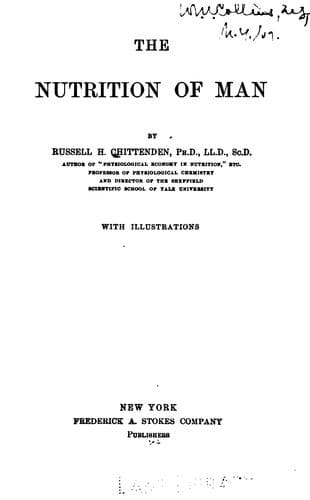
The nutrition of manChittenden, R. H. (Russell Henry)
Science
The nutrition of man
Chittenden, R. H. (Russell Henry)
Nutrition
Consider the natural character of the dietary of the great bulk
of the Japanese people, determined as it was by adverse financial
circumstances. As Oshima states, “The rural population of the
interior depends very largely or entirely upon a vegetable diet.
Fish is eaten perhaps once or twice a month, and meat once or twice
a year, if at all. The poorer working classes in the cities also
use very little animal food. But the poorer classes in the city and
the peasantry of the rural districts comprise nearly 75 per cent of
the total population, and it is therefore safe to assume that this
proportion lives chiefly, or wholly, upon vegetable diet. And this,
it may be observed, means vegetarianism literally. The so-called
lacto-vegetarianism is unknown in Japan. Cows are scarce, and milk
and other dairy products are expensive, and such as are available are
consumed almost entirely by the wealthier people in the cities.” It is
also to be noted that the amount of fat in Japanese dietaries is very
small. The reported data indicate that the usual vegetable dietaries
contain only about 10 grams of fat per day, while even in the average
mixed dietaries the amount rarely rises above 20 grams per day. In
other words, the ordinary food of the Japanese was characterized by
great lack of variety, and with such a preponderance of carbohydrate
materials of a limited kind that it is easy to conceive of a possible
dearth of some essential or accessory element, necessary for the
preservation of that nutritive balance which aids in protection against
disease.
If the resistance of the body to disease germs and toxic influences in
general is really diminished by reducing the consumption of proteid
food below the set dietary standards, then obviously here lies a
tangible reason for the maintenance of a high proteid intake. I know
of only one series of scientific observations that bears directly on
this question. Dr. Reid Hunt of Washington has studied recently the
power of resistance to the poison acetonitrile of animals kept for some
time upon a reduced proteid diet. “My experiments,” says Dr. Hunt,
“showed in all cases that the resistance was much increased.” In other
words, the animals that had been fed a low proteid ration were able to
endure a much larger dose of the poison than corresponding animals on
their customary diet; “they resisted 2–3 times the ordinary fatal dose
of acetonitrile.” This general subject, however, is obviously a very
important one, and merits further experimental study under a diversity
of conditions.
Public-domain text, read in full here on John Shaqi.
Reviews
Reviews
No reviews yet
Be the first to share your thoughts on this work.
Elsewhere in the archive
Join the Discussion
Join the discussion
Sign in to leave a comment or review.
Sign InorCreate an account