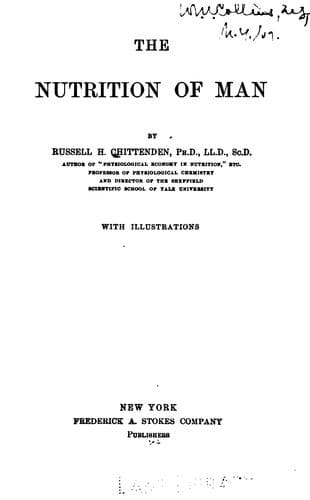
The nutrition of manChittenden, R. H. (Russell Henry)
Science
The nutrition of man
Chittenden, R. H. (Russell Henry)
Nutrition
The adoption of dietary habits that aim to accord with the
physiological requirements of the body does not compel a crucifying of
the flesh or a disregard of personal likes and dislikes. A reasonable
intelligence combined with a disposition to exercise the same degree
of judgment and care in the nutrition of the body as is expended on
other matters, of no greater importance, pertaining to the individual,
to the household, or to business interests, are all that is needed to
bring about harmony between every-day dietary habits and the nutritive
requirements of the body. There is no occasion, unless one finds
pleasure and satisfaction in so doing, to resort to a limited dietary
of nuts and fruits, to become an ardent disciple of vegetarianism,
to adopt a cereal diet, to abjure meats entirely, or to follow in an
intensive fashion any particular dietary hobby, except so far as may
be necessary to insure an adequate amount of non-nitrogenous foods to
meet the energy requirements of the body without unduly increasing
the intake of proteid or nitrogenous food. Naturally, a man leading
a life of great physical activity with the consequent demand for a
large energy-yielding intake will be compelled to resort largely to
vegetable foods, rich in starch and poor in proteid, or to eat largely
of fatty foods. Reliance on meats and animal foods in general, under
such conditions, would plainly involve a high proteid intake with a
consequent high nitrogen metabolism, with the chance that even then the
energy requirement would not be fully met.
In view of all that has been said, reinforced by the various facts
brought forward as evidence, we must recognize the value of the
non-nitrogenous foods as a source of energy, and this means plainly
food from the plant kingdom. In any rational diet, vegetable foods of
low nitrogen-content must predominate, while animal foods with their
higher nitrogen values must be greatly subordinate in amount, if the
nitrogen or proteid metabolism of the body is to be maintained at a
level commensurate with true physiological requirements. But there
comes the ever-recurring question, Are the lower proteid standards
quite safe to follow? Are we warranted in turning aside from the
teachings based on the habits and customs of mankind? Many reasons have
already been presented which seemingly justify an affirmative answer,
while the experimental results and the observations on various groups
of people, covering years of time, speak with no uncertainty regarding
the element of safety, and indicate clearly that the absolute proteid
requirement of the body is quite small; much smaller indeed than
the amount of proteid food consumed by the average individual would
seemingly imply.
Public-domain text, read in full here on John Shaqi.
Reviews
Reviews
No reviews yet
Be the first to share your thoughts on this work.
Elsewhere in the archive
Join the Discussion
Join the discussion
Sign in to leave a comment or review.
Sign InorCreate an account