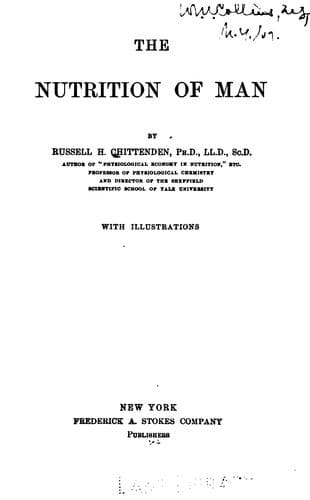
The nutrition of manChittenden, R. H. (Russell Henry)
Science
The nutrition of man
Chittenden, R. H. (Russell Henry)
Nutrition
In illustration of these statements, we have some recent results
obtained by Watson and Hunter[71] upon the influence of diet on
growth and nutrition. These investigators find that young rats--two
and a half months old--when fed upon a diet composed exclusively of
horse-flesh, which is chiefly proteid matter with some fat, succumb
very quickly, for some reason. Of fourteen young rats fed on this meat
diet, six died on the third day. On the morning of this day, as the
authors state, “the rats appeared to be in their usual health, but
an hour after feeding one of them was lying on its side apparently
unconscious. In a few minutes others were affected. They appeared to be
paralyzed, they felt cold to the touch, exhibited symptoms of tetany,
and speedily became unconscious. Six succumbed within half-an-hour. Of
the remainder, some showed similar symptoms, although in less degree,
and they recovered when the diet was changed to bread and skim milk.”
After two days of the so-called normal diet, composed of bread and skim
milk, the remaining eight rats were again placed on an exclusive meat
diet. They appeared now to have acquired a certain degree of immunity,
for although they exhibited symptoms of deranged nutrition, these were
gradually recovered from and they gained in weight. At the end of the
eighth month, five of the animals were still alive and in apparent good
health, but their growth was permanently stunted. With an exclusive
diet of ox-flesh, young rats were much more liable to thrive, although
their growth was distinctly retarded.
[71] Chalmers Watson, M.D., and Andrew Hunter, M.B.: Observations
on Diet. The Influence of Diet on Growth and Nutrition. Journal of
Physiology, Vol. XXXIV, p. 112, 1906.
This difference in the behavior of the animals towards the two
forms of proteid food is to be attributed to the fact that ox-flesh
contains more fat than horse-flesh, and consequently the diet with
this form of meat was less exclusively proteid in character. Further,
there were some indications that horse-flesh is less digestible than
ox-flesh. Another fact, showing the far-reaching effect of a distinctly
unphysiological diet, is the marked influence of pure meat food on the
progeny. Thus, of 93 rats born of meat-fed parents only 19 were alive
at the end of two months, while of 97 young born of bread and milk-fed
rats, 82 were alive and in apparent health at the end of the same
period.
Public-domain text, read in full here on John Shaqi.
Reviews
Reviews
No reviews yet
Be the first to share your thoughts on this work.
Elsewhere in the archive
Join the Discussion
Join the discussion
Sign in to leave a comment or review.
Sign InorCreate an account