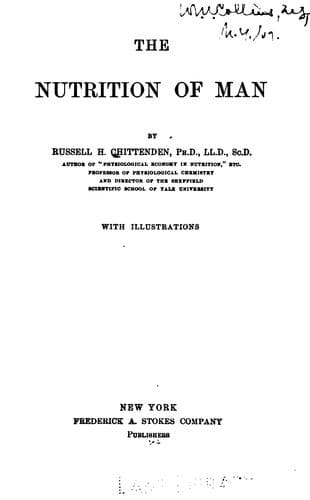
The nutrition of manChittenden, R. H. (Russell Henry)
Science
The nutrition of man
Chittenden, R. H. (Russell Henry)
Nutrition
We may recognize in these statements a physiological demand for a
certain amount of salt, especially when vegetable foods enter into
the daily dietary, but there is no justification for the employment
of such quantities as are generally made use of. Where the vegetable
food is largely rice, a small fraction of a gram of salt is really
sufficient for all physiological purposes; and in those cases where
ordinary cereals, legumes, potatoes, etc., constitute the chief part
of the dietary, a few grams of salt, at the most, will suffice to meet
the daily needs. Common usage, however, frequently raises the amount
consumed to 25 grams or more per day, the bulk of which is at once
eliminated through the kidneys; thereby entailing a certain amount
of renal activity, which must, it would seem, constitute something
of a strain upon organs ordinarily hard worked at the best. “Do we
not impose too great a task upon them, and may it not be fraught
with serious consequences? When on a diet of meat and bread, without
salt, we excrete not more than from 6 to 8 grams of alkaline salts
in twenty-four hours. With a diet of potatoes, and a corresponding
addition of salt, over 100 grams of alkaline salts pass through the
kidneys in the day. May not there be danger in this? The habit of
drinking spirituous liquors, which moreover is reckoned one of the
causes of chronic nephritis, also brings about the immoderate use of
salt, and thus one sin against nature leads to another” (Bunge).
The moral we would draw (from these observations) is that in weakened
conditions of the kidneys there is reason in reducing the rate of
proteid exchange to the lowest level consistent with the maintenance
of equilibrium and the preservation of strength and vigor, thereby
diminishing the amount of nitrogenous waste to be eliminated and the
consequent strain upon these organs. Further, there is suggested
moderation in the amount of salt to be used daily, and some
circumspection in the amount and quality of vegetable foods consumed
in order to regulate more effectually the quantity of saline waste to
be handled by the kidneys. These conclusions are just as worthy of
consideration as the more obvious rule that in diabetes or glycosuria
proper precaution must be observed in the eating of carbohydrate
foods. In gout and rheumatism, accumulated physiological knowledge
teaches plainly the necessity of avoiding those foods that are rich in
purin-containing compounds. Uric acid owes its origin in part at least
to substances of this class; and as an ounce of prevention is worth
more than a pound of cure, we may by proper moderation in the use of
such foods save ourselves from the disagreeable effects of accumulated
uric acid deposits.
Public-domain text, read in full here on John Shaqi.
Reviews
Reviews
No reviews yet
Be the first to share your thoughts on this work.
Elsewhere in the archive
Join the Discussion
Join the discussion
Sign in to leave a comment or review.
Sign InorCreate an account