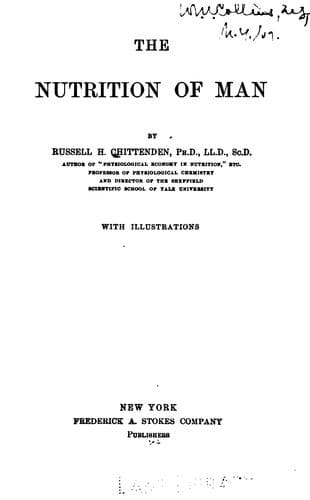
The nutrition of manChittenden, R. H. (Russell Henry)
Science
The nutrition of man
Chittenden, R. H. (Russell Henry)
Nutrition
It is claimed that the abundance of potassium salts in vegetable foods
is the cause of the apparent need for sodium chloride by herbivorous
animals, and in lesser degree by man. This is explained by supposing
that when the salts of potassium reach the blood by absorption of the
vegetable foods, an interchange takes place with the sodium chloride
of the blood plasma. “Chloride of potassium and the sodium salt of the
acid which was combined with the potassium are formed. Instead of the
chloride of sodium, therefore, the blood now contains another sodium
salt, which did not form part of the normal composition of the blood,
or at any rate not in so large a proportion. A foreign constituent
or an excess of a normal constituent, _i. e._, sodium carbonate,
has arisen in the blood. But the kidneys possess the function of
maintaining the same composition of the blood, and of thus eliminating
every abnormal constituent and any excess of a normal constituent. The
sodium salt formed is therefore ejected by the kidneys, together with
the chloride of potassium, and the blood becomes poorer in chlorine
and sodium. Common salt is therefore withdrawn from the organism by
the ingestion of potassium salts. This loss can only be made up from
without, and this explains the fact that animals which live on a diet
rich in potassium, have a longing for salt” (Bunge). It is certainly a
fact worthy of note that man takes only one salt as such in addition
to those that are naturally present in his food, and it is equally
significant that sodium chloride is by no means lacking in ordinary
foodstuffs. If the individual lives entirely on animal foods, he has no
desire for salt, but as soon as he adopts a vegetable diet the craving
for salt shows itself. Vegetable foods, however, are not all alike in
their content of potassium salts; some, like rice, contain relatively
little, while others, like potatoes, peas, and beans, are comparatively
rich in this element.
Public-domain text, read in full here on John Shaqi.
Reviews
Reviews
No reviews yet
Be the first to share your thoughts on this work.
Elsewhere in the archive
Join the Discussion
Join the discussion
Sign in to leave a comment or review.
Sign InorCreate an account