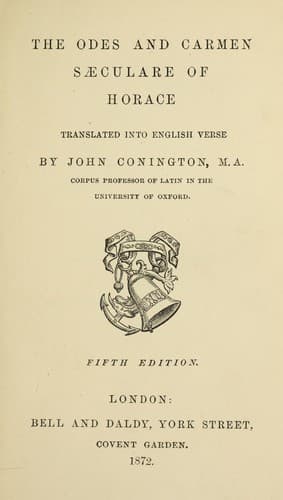
The Odes and Carmen Saeculare of Horace — John Shaqi
The Odes and Carmen Saeculare of HoraceHorace
General
The Odes and Carmen Saeculare of Horace
Horace
Horace -- Translations into English; Laudatory poetry, Latin -- Translations into English
omnes" I have made another iambic combination, the six-syllable with
the fourteen-syllable, arranged as a couplet. The choriambic I thought
might be exchanged for a heroic stanza, in which the first line should
rhyme with the fourth, the second with the third, a kind of "In
Memoriam" elongated. Lastly, I have chosen the heroic quatrain proper,
the metre of Gray's "Elegy," for the two Odes in the First Book written
in what is called the Metrum Alcmanium, "Laudabunt alii," and "Te maris
et terrae," rather from a vague notion of the dignity of the measure
than from any distinct sense of special appropriateness.
From this enumeration, which I fear has been somewhat tedious, it will
be seen that I have been guided throughout not by any systematic
principles, but by a multitude of minor considerations, some operating
more strongly in one case, and some in another. I trust, however, that
in all this diversity I shall be found to have kept in view the object
on which I have been insisting, a metrical correspondence with the
original. Even where I have been most inconsistent, I have still
adhered to the rule of comprising the English within the same number of
lines as the Latin. I believe tills to be almost essential to the
preservation of the character of the Horatian lyric, which always
retains a certain severity, and never loses itself in modern
exuberance; and though I am well aware that the result in my case has
frequently, perhaps generally, been a most un-Horatian stiffness, I am
convinced from my own experience that a really accomplished artist
would find the task of composing under these conditions far more
hopeful than he had previously imagined it to be. Yet it is a restraint
to which scarcely any of the previous translators of the Odes have been
willing to submit. Perhaps Professor Newman is the only one who has
carried it through the whole of the Four Books; most of my predecessors
have ignored it altogether. It is this which, in my judgment, is the
chief drawback to the success of the most distinguished of them, Mr.
Theodore Martin. He has brought to his work a grace and delicacy of
expression and a happy flow of musical verse which are beyond my
praise, and which render many of his Odes most pleasing to read as
poems. I wish he had combined with these qualities that terseness and
condensation which remind us that a Roman, even when writing "songs of
love and wine," was a Roman still.
Public-domain text, read in full here on John Shaqi.
Reviews
Reviews
No reviews yet
Be the first to share your thoughts on this work.
Join the Discussion
Join the discussion
Sign in to leave a comment or review.
Sign InorCreate an account