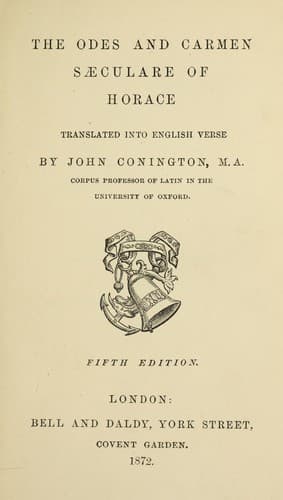
Horace -- Translations into English; Laudatory poetry, Latin -- Translations into English
The first thing at which, as it seems to me, a Horatian translator
ought to aim, is some kind of metrical conformity to his original.
Without this we are in danger of losing not only the metrical, but the
general effect of the Latin; we express ourselves in a different
compass, and the character of the expression is altered accordingly.
For instance, one of Horace's leading features is his occasional
sententiousness. It is this, perhaps more than anything else, that has
made him a storehouse of quotations. He condenses a general truth in a
few words, and thus makes his wisdom portable. "Non, si male nunc, et
olim sic erit;" "Nihil est ab omni parte beatum;" "Omnes eodem
cogimur,"--these and similar expressions remain in the memory when
other features of Horace's style, equally characteristic, but less
obvious, are forgotten. It is almost impossible for a translator to do
justice to this sententious brevity unless the stanza in which he
writes is in some sort analogous to the metre of Horace. If he chooses
a longer and more diffuse measure, he will be apt to spoil the proverb
by expansion; not to mention that much will often depend on the very
position of the sentence in the stanza. Perhaps, in order to preserve
these external peculiarities, it may be necessary to recast the
expression, to substitute, in fact, one form of proverb for another;
but this is far preferable to retaining the words in a diluted form,
and so losing what gives them their character, I cannot doubt, then,
that it is necessary in translating an Ode of Horace to choose some
analogous metre; as little can I doubt that a translator of the Odes
should appropriate to each Ode some particular metre as its own. It may
be true that Horace himself does not invariably suit his metre to his
subject; the solemn Alcaic is used for a poem in dispraise of serious
thought and praise of wine; the Asclepiad stanza in which Quintilius is
lamented is employed to describe the loves of Maecenas and Licymnia.
But though this consideration may influence us in our choice of an
English metre, it is no reason for not adhering to the one which we may
have chosen. If we translate an Alcaic and a Sapphic Ode into the same
English measure, because the feeling in both appears to be the same, we
are sure to sacrifice some important characteristic of the original in
the case of one or the other, perhaps of both. It is better to try to
make an English metre more flexible than to use two different English
metres to represent two different aspects of one measure in Latin. I am
sorry to say that I have myself deviated from this rule occasionally,
under circumstances which I shall soon have to explain; but though I
may perhaps succeed in showing that my offences have not been serious,
I believe the rule itself to be one of universal application, always
honoured in the observance, if not always equally dishonoured in the
breach.
Public-domain text, read in full here on John Shaqi.
Reviews
Reviews
No reviews yet
Be the first to share your thoughts on this work.
Join the Discussion
Join the discussion
Sign in to leave a comment or review.
Sign InorCreate an account