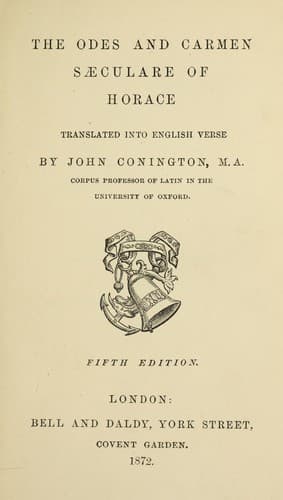
Horace -- Translations into English; Laudatory poetry, Latin -- Translations into English
The Sapphic and the Alcaic involve more difficult questions. Here,
however, as in the Asclepiad, I believe we must be guided, to some
extent, by external similarity. We must choose the iambic movement as
being most congenial to English; we must avoid the ten-syllable iambic
as already appropriated to the longer Asclepiad line. This leads me to
conclude that the staple of each stanza should be the eight-syllable
iambic, a measure more familiar to English lyric poetry than any other,
and as such well adapted to represent the most familiar lyric measures
of Horace. With regard to the Sapphic, it seems desirable that it
should be represented by a measure of which the three first lines are
eight-syllable iambics, the fourth some shorter variety. Of this
stanza there are at least two kinds for which something might be said.
It might be constructed so that the three first lines should rhyme with
each other, the fourth being otherwise dealt with; or it might be
framed on the plan of alternate rhymes, the fourth line still being
shorter than the rest. Of the former kind two or three specimens are to
be found in Francis' translation of Horace. In these the fourth line
consists of but three syllables, the two last of which rhyme with the
two last syllables of the fourth line of the next succeeding stanza, as
for instance:--
You shoot; she whets her tusks to bite;
While he who sits to judge the fight
Treads on the palm with foot so white,
Disdainful,
And sweetly floating in the air
Wanton he spreads his fragrant hair,
Like Ganymede or Nireus fair,
And vainful.
Public-domain text, read in full here on John Shaqi.
Reviews
Reviews
No reviews yet
Be the first to share your thoughts on this work.
Join the Discussion
Join the discussion
Sign in to leave a comment or review.
Sign InorCreate an account