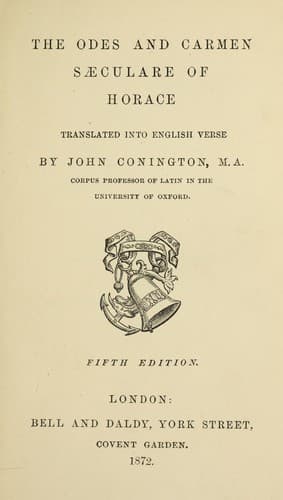
The Odes and Carmen Saeculare of Horace — John Shaqi
The Odes and Carmen Saeculare of HoraceHorace
General
The Odes and Carmen Saeculare of Horace
Horace
Horace -- Translations into English; Laudatory poetry, Latin -- Translations into English
For the place of the Alcaic there are various candidates. Mr. Tennyson
has recently invented a measure which, if not intended to reproduce the
Alcaic, was doubtless suggested by it, that which appears in his poem
of "The Daisy," and, in a slightly different form, in the "Lines to Mr.
Maurice." The two last lines of the latter form of the stanza are
indeed evidently copied from the Alcaic, with the simple omission of
the last syllable of the last line of the original. Still, as a whole,
I doubt whether this form would be as suitable, at least for a
dignified Ode, as the other, where the initial iambic in the last line,
substituted for a trochec, makes the movement different. I was
deterred, however, from attempting either, partly by a doubt whether
either had been sufficiently naturalized in English to be safely
practised by an unskilful hand, partly by the obvious difficulty of
having to provide three rhymes per stanza, against which the occurrence
of one line in each without a rhyme at all was but a poor set-off. A
second metre which occurred to me is that of Andrew Marvel's Horatian
Ode, a variety of which is found twice in Mr. Keble's Christian Year.
Here two lines of eight syllables are followed by two of six, the
difference between the types being that in Marvel's Ode the rhymes are
successive, in Mr. Keble's alternate. The external correspondence
between this and the Alcaic is considerable; but the brevity of the
English measure struck me at once as a fatal obstacle, and I did not
try to encounter it. A third possibility is the stanza of "In
Memoriam," which has been adopted by the clever author of "Poems and
Translations, by C. S. C.," in his version of "Justum et tenacem." I
think it very probable that this will be found eventually to be the
best representation of the Alcaic in English, especially as it appears
to afford facilities for that linking of stanza to stanza which one who
wishes to adhere closely to the logical and rhythmical structure of the
Latin soon learns to desire. But I have not adopted it; and I believe
there is good reason for not doing so. With all its advantages, it has
the patent disadvantage of having been brought into notice by a poet
who is influencing the present generation as only a great living poet
can. A great writer now, an inferior writer hereafter, may be able to
handle it with some degree of independence; but the majority of those
who use it at present are sure in adopting Mr. Tennyson's metre to
adopt his manner. It is no reproach to "C. S. C." that his Ode reminds
us of Mr. Tennyson; it is a praise to him that the recollection is a
pleasant one. But Mr. Tennyson's manner is not the manner of Horace,
and it is the manner of a contemporary; the expression--a most powerful
and beautiful expression--of influences to which a translator of an
ancient classic feels himself to be too much subjected already. What is
wanted is a metre which shall have other associations than those of the
Public-domain text, read in full here on John Shaqi.
Reviews
Reviews
No reviews yet
Be the first to share your thoughts on this work.
Join the Discussion
Join the discussion
Sign in to leave a comment or review.
Sign InorCreate an account