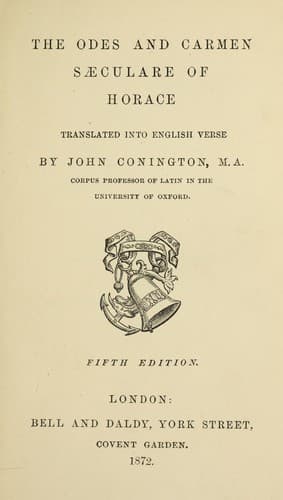
Horace -- Translations into English; Laudatory poetry, Latin -- Translations into English
The problem of finding English representatives for the other Horatian
metres, if a more difficult, is a less important one. The most pressing
case is that of the metre known as the second Asclepiad, the "Sic te
diva potens Cypri." With this, I fear, I shall be thought to have dealt
rather capriciously, having rendered it by four different measures,
three of them, however, varieties of the same general type. It so
happens that the first Ode which I translated was the celebrated
Amoebean Poem, the dialogue between Horace and Lydia. I had had at that
time not the most distant notion of translating the whole of the Odes,
or even any considerable number of them, so that in choosing a metre I
thought simply of the requirements of the Ode in question, not of those
of the rest of its class. Indeed, I may say that it was the thought of
the metre which led me to try if I could translate the Ode. Having
accomplished my attempt, I turned to another Ode of the same class, the
scarcely less celebrated "Quem tu, Melpomene." For this I took a
different metre, which happens to be identical with that of a solitary
Ode in the Second Book, "Non ebur neque aureum," being guided still by
my feeling about the individual Ode, not by any more general
considerations. I did not attempt a third until I had proceeded
sufficiently far in my undertaking to see that I should probably
continue to the end. Then I had to consider the question of a uniform
metre to answer to the Latin. Both of those which I had already tried
were rendered impracticable by a double rhyme, which, however
manageable in one or two Odes, is unmanageable, as I have before
intimated, in the case of a large number. The former of the two
measures, divested of the double rhyme, would, I think, lose most of
its attractiveness; the latter suffers much less from the privation:
the latter accordingly I chose. The trochaic character of the first
line seems to me to give it an advantage over any metre composed of
pure iambics, if it were only that it discriminates it from those
alternate ten-syllable and eight-syllable iambics into which it would
be natural to render many of the Epodes. At the same time, it did not
appear worth while to rewrite the two Odes already translated, merely
for the sake of uniformity, as the principle of correspondence to the
Latin, the alternation of longer and shorter lines, is really the same
in all three cases. Nay, so tentative has been my treatment of the
whole matter, that I have even translated one Ode, the third of Book I,
into successive rather than into alternate rhymes, so that readers may
judge of the comparative effect of the two varieties. After this
confession of irregularity, I need scarcely mention that on coming to
the Ode which had suggested the metre in its unmutilated state, I
translated it into the mutilated form, not caring either to encounter
the inconvenience of the double rhymes, or to make confusion worse
Public-domain text, read in full here on John Shaqi.
Reviews
Reviews
No reviews yet
Be the first to share your thoughts on this work.
Join the Discussion
Join the discussion
Sign in to leave a comment or review.
Sign InorCreate an account