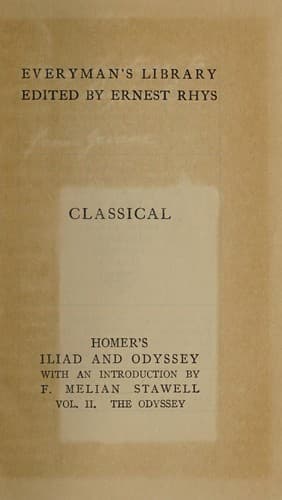
Epic poetry, Greek -- Translations into English; Homer -- Translations into English; Odysseus, King of Ithaca (Mythological character)
And the goddess, grey-eyed Athene, answered him, saying: “O father, our
father Cronides, throned in the highest; that man assuredly lies in a
death that is his due; so perish likewise all who work such deeds! But
my heart is rent for wise Odysseus, that hapless one, who far from his
friends this long while suffereth affliction in a seagirt isle, where
is the navel of the sea, a woodland isle, and therein a goddess hath
her habitation, the daughter of the wizard Atlas, who knows the depths
of every sea, and himself upholds the tall pillars which keep earth and
sky asunder. His daughter it is that holds the hapless man in sorrow:
and ever with soft and guileful tales she is wooing him to
forgetfulness of Ithaca. But Odysseus yearning to see if it were but
the smoke leap upwards from his own land, hath a desire to die. As for
thee, thine heart regardeth it not at all, Olympian! What! did not
Odysseus by the ships of the Argives make thee free offering of
sacrifice in the wide Trojan land? Wherefore wast thou then so wroth
with him, O Zeus?”
And Zeus the cloud-gatherer answered her, and said, “My child, what
word hath escaped the door of thy lips? Yea, how should I forget divine
Odysseus, who in understanding is beyond mortals and beyond all men
hath done sacrifice to the deathless gods, who keep the wide heaven?
Nay, but it is Poseidon, the girdler of the earth, that hath been wroth
continually with quenchless anger for the Cyclops’ sake whom he blinded
of his eye, even godlike Polyphemus whose power is mightiest amongst
all the Cyclôpes. His mother was the nymph Thoösa, daughter of Phorcys,
lord of the unharvested sea, and in the hollow caves she lay with
Poseidon. From that day forth Poseidon the earth-shaker doth not indeed
slay Odysseus, but driveth him wandering from his own country. But
come, let us here one and all take good counsel as touching his
returning, that he may be got home; so shall Poseidon let go his
displeasure, for he will in no wise be able to strive alone against
all, in despite of all the deathless gods.”
Public-domain text, read in full here on John Shaqi.
Reviews
Reviews
No reviews yet
Be the first to share your thoughts on this work.
Join the Discussion
Join the discussion
Sign in to leave a comment or review.
Sign InorCreate an account