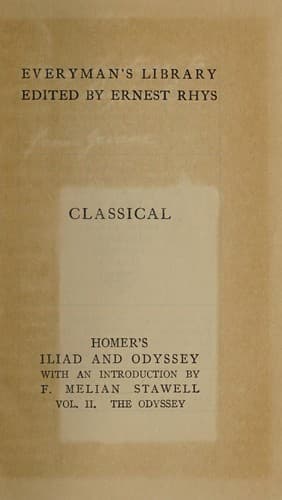
Epic poetry, Greek -- Translations into English; Homer -- Translations into English; Odysseus, King of Ithaca (Mythological character)
“Oh, woe is me, unto what mortals’ land am I now come? Say, are they
froward, and wild, and unjust, or hospitable and of a god-fearing mind?
Whither do I bear all this treasure? Yea, where am I wandering myself?
Oh that the treasure had remained with the Phaeacians where it was, so
had I come to some other of the mighty princes, who would have
entreated me kindly and sent me on my way. But now I know not where to
bestow these things, nor yet will I leave them here behind, lest haply
other men make spoil of them. Ah then, they are not wholly wise or
just, the princes and counsellors of the Phaeacians, who carried me to
a strange land. Verily they promised to bring me to clear-seen Ithaca,
but they performed it not. May Zeus requite them, the god of
suppliants, seeing that he watches over all men and punishes the
transgressor! But come, I will reckon up these goods and look to them,
lest the men be gone, and have taken aught away upon their hollow
ship.”
Therewith he set to number the fair tripods and the cauldrons and the
gold and the goodly woven raiment; and of all these he lacked not
aught, but he bewailed him for his own country, as he walked downcast
by the shore of the sounding sea, and made sore lament. Then Athene
came nigh him in the guise of a young man, the herdsman of a flock, a
young man most delicate, such as are the sons of kings. And she had a
well-wrought mantle that fell in two folds about her shoulders, and
beneath her smooth feet she had sandals bound, and a javelin in her
hands. And Odysseus rejoiced as he saw her, and came over against her,
and uttering his voice spake to her winged words:
“Friend, since thou art the first that I have chanced on in this land,
hail to thee, and with no ill-will mayest thou meet me! Nay, save this
my substance and save me too, for to thee as to a god I make prayer,
and to thy dear knees have I come. And herein tell me true, that I may
surely know. What land, what people is this? what men dwell therein?
Surely, methinks, it is some clear seen isle, or a shore of the rich
mainland that lies and leans upon the deep.”
Then the goddess, grey-eyed Athene, spake to him again: “Thou art
witless, stranger, or thou art come from afar, if indeed thou askest of
this land; nay, it is not so very nameless but that many men know it,
both all those who dwell toward the dawning and the sun, and they that
abide over against the light toward the shadowy west. Verily it is
rough and not fit for the driving of horses, yet is it not a very sorry
isle, though narrow withal. For herein is corn past telling, and herein
too wine is found, and the rain is on it evermore, and the fresh dew.
And it is good for feeding goats and feeding kine; all manner of wood
is here, and watering-places unfailing are herein. Wherefore, stranger,
the name of Ithaca hath reached even unto Troy-land, which men say is
far from this Achaean shore.”
Public-domain text, read in full here on John Shaqi.
Reviews
Reviews
No reviews yet
Be the first to share your thoughts on this work.
Elsewhere in the archive
Join the Discussion
Join the discussion
Sign in to leave a comment or review.
Sign InorCreate an account