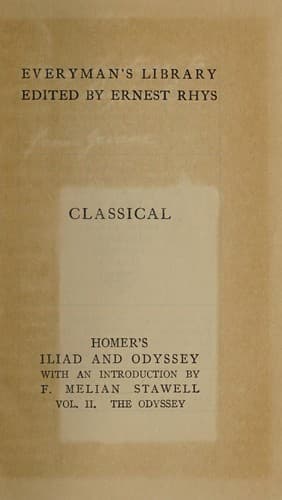
Epic poetry, Greek -- Translations into English; Homer -- Translations into English; Odysseus, King of Ithaca (Mythological character)
Now when Menelaus, of the loud war cry, heard this saying, straightway
he bade his wife and maids to prepare the midday meal in the halls, out
of the good store they had by them. Then Eteoneus, son of Boethous,
came nigh him, just risen from his bed, for he abode not far from him.
Him Menelaus of the loud war cry bade kindle the fire and roast of the
flesh; and he hearkened and obeyed. Then the prince went down into the
fragrant treasure chamber, not alone, for Helen went with him, and
Megapenthes. Now, when they came to the place where the treasures were
stored, then Atrides took a two-handled cup, and bade his son
Megapenthes to bear a mixing bowl of silver. And Helen stood by the
coffers, wherein were her robes of curious needlework which she herself
had wrought. Then Helen, the fair lady, lifted one and brought it out,
the widest and most beautifully embroidered of all, and it shone like a
star, and lay far beneath the rest.
Then they went forth through the house till they came to Telemachus;
and Menelaus, of the fair hair, spake to him saying:
“Telemachus, may Zeus the thunderer, and the lord of Here, in very
truth bring about thy return according to the desire of thy heart. And
of the gifts, such as are treasures stored in my house, I will give
thee the goodliest and greatest of price. I will give thee a mixing
bowl beautifully wrought; it is all of silver and the lips thereof are
finished with gold, the work of Hephaestus; and the hero Phaedimus the
king of the Sidonians, gave it to me when his house sheltered me, on my
coming thither. This cup I would give to thee.”
Therewith the hero Atrides set the two-handled cup in his hands. And
the strong Megapenthes bare the shining silver bowl and set it before
him. And Helen came up, beautiful Helen, with the robe in her hands,
and spake and hailed him:
“Lo! I too give thee this gift, dear child, a memorial of the hands of
Helen, against the day of thy desire, even of thy bridal, for thy bride
to wear it. But meanwhile let it lie by thy dear mother in her chamber.
And may joy go with thee to thy well-builded house, and thine own
country.”
Public-domain text, read in full here on John Shaqi.
Reviews
Reviews
No reviews yet
Be the first to share your thoughts on this work.
Elsewhere in the archive
Join the Discussion
Join the discussion
Sign in to leave a comment or review.
Sign InorCreate an account