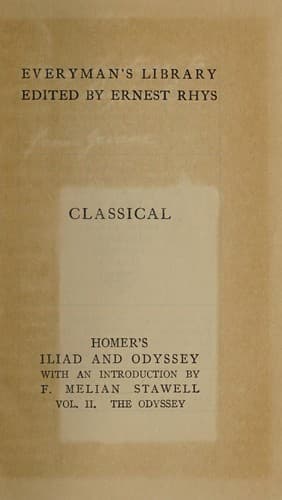
Epic poetry, Greek -- Translations into English; Homer -- Translations into English; Odysseus, King of Ithaca (Mythological character)
And wise Telemachus answered him, and said: “Nestor, son of Neleus,
great glory of the Achaeans, verily and indeed he avenged himself, and
the Achaeans shall noise his fame abroad, that even those may hear who
are yet for to be. Oh that the gods would clothe me with such strength
as his, that I might take vengeance on the wooers for their cruel
transgression, who wantonly devise against me infatuate deeds! But the
gods have woven for me the web of no such weal, for me or for my sire.
But now I must in any wise endure it.”
Then Nestor of Gerenia, lord of chariots, made answer: “Dear friend,
seeing thou dost call these things to my remembrance and speak thereof,
they tell me that many wooers for thy mother’s hand plan mischief
within the halls in thy despite. Say, dost thou willingly submit thee
to oppression, or do the people through the land hate thee, obedient to
the voice of a god? Who knows but that Odysseus may some day come and
requite their violence, either himself alone or all the host of the
Achaeans with him? Ah, if but grey-eyed Athene were inclined to love
thee, as once she cared exceedingly for the renowned Odysseus in the
land of the Trojans, where we Achaeans were sore afflicted, for never
yet have I seen the gods show forth such manifest love, as then did
Pallas Athene standing manifest by him,—if she would be pleased so to
love thee and to care for thee, then might certain of them clean forget
their marriage.”
And wise Telemachus answered him, saying: “Old man, in no wise methinks
shall this word be accomplished. This is a hard saying of thine, awe
comes over me. Not for my hopes shall this thing come to pass, not even
if the gods so willed it.”
Then the goddess, grey-eyed Athene, spake to him again: “Telemachus,
what word hath escaped the door of thy lips? Lightly might a god, if so
he would, bring a man safe home even from afar. Rather myself would I
have travail and much pain ere I came home and saw the day of my
returning, than come back and straightway perish on my own
hearth-stone, even as Agamemnon perished by guile at the hands of his
own wife and of Aegisthus. But lo you, death, which is common to all,
the very gods cannot avert even from the man they love, when the
ruinous doom shall bring him low of death that lays men at their
length.”
Public-domain text, read in full here on John Shaqi.
Reviews
Reviews
No reviews yet
Be the first to share your thoughts on this work.
Join the Discussion
Join the discussion
Sign in to leave a comment or review.
Sign InorCreate an account