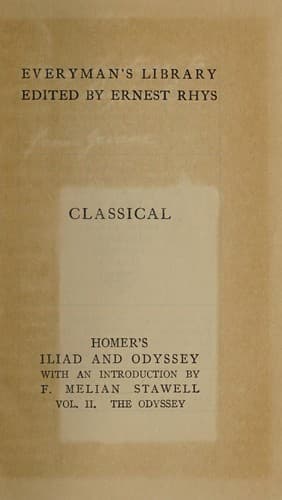
Epic poetry, Greek -- Translations into English; Homer -- Translations into English; Odysseus, King of Ithaca (Mythological character)
Agamemnon, shepherd of the people; but caitiff thoughts were in his
heart. He brought him up to his house, all unwitting of his doom, and
when he had feasted him slew him, as one slayeth an ox at the stall.
And none of the company of Atreides that were of his following were
left, nor any of the men of Aegisthus, but they were all killed in the
halls.’
“So spake he, and my spirit within me was broken, and I wept as I sat
upon the sand, nor was I minded any more to live and see the light of
the sun. But when I had taken my fill of weeping and grovelling on the
ground, then spake the ancient one of the sea, whose speech is sooth:
“‘No more, son of Atreus, hold this long weeping without cease, for we
shall find no help therein. Rather with all haste make essay that so
thou mayest come to thine own country. For either thou shalt find
Aegisthus yet alive, or it may be Orestes was beforehand with thee and
slew him; so mayest thou chance upon his funeral feast.’
“So he spake, and my heart and lordly soul again were comforted for all
my sorrow, and I uttered my voice and I spake to him winged words:
“‘Their fate I now know; but tell me of the third; who is it that is
yet living and holden on the wide deep, or perchance is dead? and fain
would I hear despite my sorrow.’
“So spake I, and straightway he answered, and said: ‘It is the son of
Laertes, whose dwelling is in Ithaca; and I saw him in an island
shedding big tears in the halls of the nymph Calypso, who holds him
there perforce; so he may not come to his own country, for he has by
him no ships with oars, and no companions to send him on his way over
the broad back of the sea. But thou, Menelaus, son of Zeus, art not
ordained to die and meet thy fate in Argos, the pasture-land of horses,
but the deathless gods will convey thee to the Elysian plain and the
world’s end, where is Rhadamanthus of the fair hair, where life is
easiest for men. No snow is there, nor yet great storm, nor any rain;
but always ocean sendeth forth the breeze of the shrill West to blow
cool on men; yea, for thou hast Helen to wife, and thereby they deem
thee to be son of Zeus.’
Public-domain text, read in full here on John Shaqi.
Reviews
Reviews
No reviews yet
Be the first to share your thoughts on this work.
Elsewhere in the archive
Join the Discussion
Join the discussion
Sign in to leave a comment or review.
Sign InorCreate an account