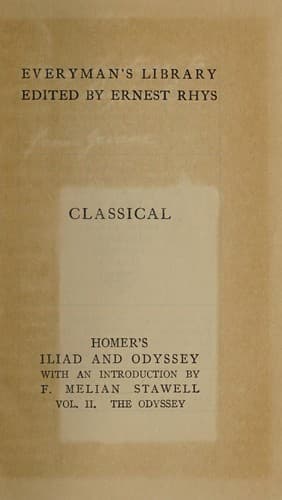
Epic poetry, Greek -- Translations into English; Homer -- Translations into English; Odysseus, King of Ithaca (Mythological character)
He spake and led the way, and the sceptred kings accompanied him, while
the henchmen went for the divine minstrel. And chosen youths, fifty and
two, departed at his command, to the shore of the unharvested sea. But
after they had gone down to the ship and to the sea, first of all they
drew the ship down to the deep water, and placed the mast and sails in
the black ship, and fixed the oars in leathern loops, all orderly, and
spread forth the white sails. And they moored her high out in the shore
water, and thereafter went on their way to the great palace of the wise
Alcinous. Now the galleries and the courts and the rooms were thronged
with men that came to the gathering, for there were many, young and
old. Then Alcinous sacrificed twelve sheep among them, and eight boars
with flashing tusks, and two oxen with trailing feet. These they flayed
and made ready, and dressed a goodly feast.
Then the henchman drew near, leading with him the beloved minstrel,
whom the muse loved dearly, and she gave him both good and evil; of his
sight she reft him, but granted him sweet song. Then Pontonous, the
henchman, set for him a high chair inlaid with silver, in the midst of
the guests, leaning it against the tall pillar, and he hung the loud
lyre on a pin, close above his head, and showed him how to lay his
hands on it. And close by him he placed a basket, and a fair table, and
a goblet of wine by his side, to drink when his spirit bade him. So
they stretched forth their hands upon the good cheer spread before
them. But after they had put from them the desire of meat and drink,
the Muse stirred the minstrel to sing the songs of famous men, even
that lay whereof the fame had then reached the wide heaven, namely, the
quarrel between Odysseus and Achilles, son of Peleus; how once on a
time they contended in fierce words at a rich festival of the gods, but
Agamemnon, king of men, was inly glad when the noblest of the Achaeans
fell at variance. For so Phoebus Apollo in his soothsaying had told him
that it must be, in goodly Pytho, what time he crossed the threshold of
stone, to seek to the oracle. For in those days the first wave of woe
was rolling on Trojans and Danaans through the counsel of great Zeus.
Public-domain text, read in full here on John Shaqi.
Reviews
Reviews
No reviews yet
Be the first to share your thoughts on this work.
Elsewhere in the archive
Join the Discussion
Join the discussion
Sign in to leave a comment or review.
Sign InorCreate an account