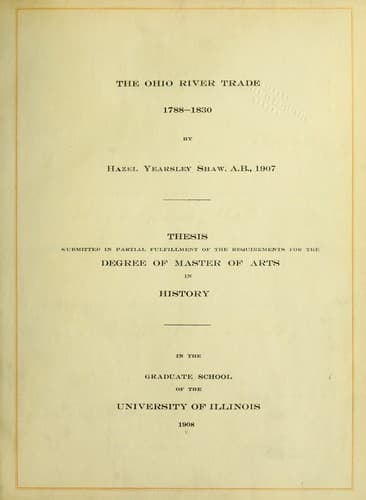
The Ohio River Trade, 1788-1830Shaw, Hazel Yearsley
History
The Ohio River Trade, 1788-1830
Shaw, Hazel Yearsley
Ohio River -- History; Ohio River Valley -- History
Forman in 1789-1790, made a journey down the Ohio, and mentions the
arrival, at Louisville, of four tobacco boats, on their way to New
Orleans.[52] Furs were sent up the Ohio from Illinois to Pittsburg,
as early as 1790, as is shown by the following from a letter
written by St. Clair, "There is no doubt that the furs of that
country might be brought up the Ohio River at as little or even
less expense than attends the carriage of them to Canada. It has
been tried by one person, a Mr. Vigo, and found to answer; although
the goods he carried out were transported by land from Philadelphia
to Pittsburg, and loaded with an impost the competitors were free
from, they came to market on better terms than those from Canada.
Could these also be subjected to it, a decided advantage would
be given to the American trader."[53] Pope who journeyed down the
Mississippi in 1791, speaks of meeting several boats bound down the
river, loaded with bacon, butter, flour, tobacco, and plank, and
also two large Pittsburg boats loaded with flour.[54] "The Walnut
Hills about ten miles below the Yasous River" were fixed as the
boundary line by the King of Spain, and United States citizens were
not allowed to live in Spanish territory unless they put themselves
under the laws, banners, and protection of Spain. Private
adventurers from New York, Philadelphia, and Baltimore, carried on
a tolerable trade at New Orleans, and had an advance of cent per
cent on their goods, which were nevertheless cheaper than Spanish
importations.[55]
October 27, 1795 a treaty was made with Spain containing the
following provisions: "It is likewise agreed that the western
boundary of the United States which separates them from the Spanish
Colony of Louisiana, is in the middle of the channel or bed of the
River Mississippi, from the northern boundary of the said States to
the completion of the 31st degree of latitude north of the Equator.
And his Catholic Majesty has likewise agreed that the navigation of
the said river in its whole breadth, from its source to the ocean,
shall be free only to his subjects, and the citizens of the United
States, unless he should extend this privilege to the subjects of
other powers by special convention."[56] "And in consequence of
the stipulation contained in the fourth article, His Catholic
Majesty will permit the citizens of the United States, for the
space of three years from this time, to deposit their merchandise
and effects in the port of New Orleans, and to export them from
thence, without paying any other duty than a fair price for the
hire of the Stores, and his Majesty promises either to continue
this permission, if he finds, during that time that it is not
prejudicial to the interests of Spain, or if he should not agree to
continue it there, he will assign to them, on another part of the
banks of the Mississippi, an equivalent establishment."[57]
Public-domain text, read in full here on John Shaqi.
Reviews
Reviews
No reviews yet
Be the first to share your thoughts on this work.
Join the Discussion
Join the discussion
Sign in to leave a comment or review.
Sign InorCreate an account