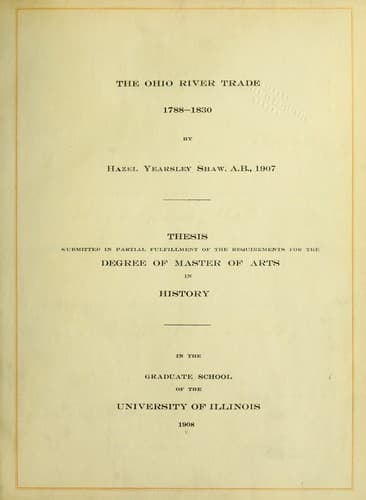
The Ohio River Trade, 1788-1830Shaw, Hazel Yearsley
History
The Ohio River Trade, 1788-1830
Shaw, Hazel Yearsley
Ohio River -- History; Ohio River Valley -- History
The canoe and pirogue were succeeded by the barge, the keel, and
the flat-boat. Of the first two, the barge was the largest, had
the greatest breadth, and the best accomodation for passengers;
the keel was longer, had less depth, and was better fitted for
the navigation of narrow and shallow channels. "They were navigated
by a rude and lawless class of men, who became distinguished as
well for their drolleries, as for their predatory and ferocious
habits. In the thinly scattered state of the population, their
numbers rendered them formidable, as there were few villages on the
rivers, and still fewer settlements, which contained a sufficient
number of able bodied men to cope with the crew of a barge,
consisting usually of thirty or forty hands; while the arrival of
several of these boats together made them completely masters of
the place. The large rivers whose meanders they pursued formed
the boundaries of States, so that living continually on the lines
which divided different civil jurisdictions, they could pass with
ease from one to the other, and never be made responsible to any.
It is a singular fact, that lawless and wild as these men were,
the valuable cargoes of merchandise committed to their care, and
secured by no other bond than their integrity, were always carried
safely to their destination, and the traveler, however weak, or
however richly freighted, relied securely on their protection."[4]
Navigating long rivers, whose shores were still infested by hostile
savages, the boatmen were armed, and depended for safety upon their
caution and their manhood.[5]
Public-domain text, read in full here on John Shaqi.
Reviews
Reviews
No reviews yet
Be the first to share your thoughts on this work.
Join the Discussion
Join the discussion
Sign in to leave a comment or review.
Sign InorCreate an account