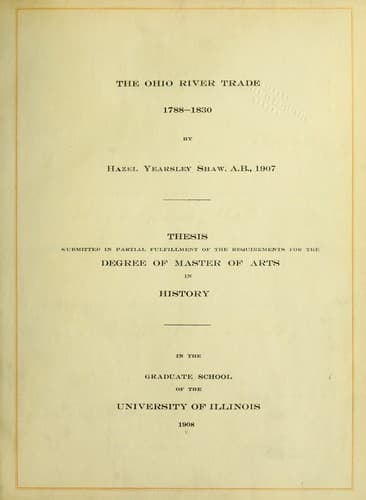
The Ohio River Trade, 1788-1830Shaw, Hazel Yearsley
History
The Ohio River Trade, 1788-1830
Shaw, Hazel Yearsley
Ohio River -- History; Ohio River Valley -- History
_CHAPTER II._
_OTHER CRAFT OF THE PERIOD._
The primitive forms of craft continued in use, upon the Ohio River,
long after the introduction of the steamboat. The business of the
country was small, and a few boats served the purpose. It was only
after the steamboats had become very common, growing in numbers
with the country, that they absorbed the great part of the carrying
trade.
The lumber from the upper river was all rafted, and in the spring
and early summer, when the water was high, the rafts were a leading
feature of the river life. They were made up through the winter
on the small branches of the Allegheny, and floated out on the
first spring freshet.[314] Sometimes several rafts would be joined
together, till they would cover an acre of space, or even more. On
these were built shanties for the men, and vast heaps of shingles,
and lath in bundles occupied a part of the space. As the region of
Pennsylvania and New York, drained by the Allegheny, was a pretty
good place to emigrate from, families were constantly leaving for
the countries down the river, and made these rafts available as the
means of moving. Indeed, for the purpose, nothing could be more
convenient, for the movers could build themselves a comfortable
shanty of the loose lumber, a shed for their horses and cows, if
they wished to take them along, and be quite at home during a
journey, that would often occupy three or four weeks.[315]
Howell says, "Often I have seen the shanties of two or three
families, with wagons, horses, cows, and even poultry, all snuggly
situated, with room for the children to play outside. I have seen
the women washing, and a clothes-line hung with the linen."[316] Hall
also gives us a pleasing account of this mode of travel. "Today we
passed two large rafts lashed together, by which simple conveyance
several families from New England were transporting themselves and
their property to the land of promise in the western woods. Each
raft was 80 or 90 feet long, with a small house erected on it, and
on each was a stack of hay, round which several horses and cows
were feeding, while the paraphernalia of a farm yard, the ploughs,
wagons, pigs, children, and poultry, carelessly distributed, gave
to the whole more the appearance of a permanent residence, than
of a caravan of adventurere seeking a home. In this manner these
people travel at slight expense."[317]
The smaller forms of boats, the skiffs, and the pirogue were still
in use on the Ohio. The total expense of two people, for a voyage
of seven hundred miles in a skiff, down the Ohio, was but seven
dollars each.[318] Birkbeck speaks of forming two pirogues, out of
large poplars, lashing them together, and placing large planks
across both, thus creating a roomy deck and good covered stowage,
making it possible to take a bulky as well as a heavy cargo.[319]
Public-domain text, read in full here on John Shaqi.
Reviews
Reviews
No reviews yet
Be the first to share your thoughts on this work.
Join the Discussion
Join the discussion
Sign in to leave a comment or review.
Sign InorCreate an account