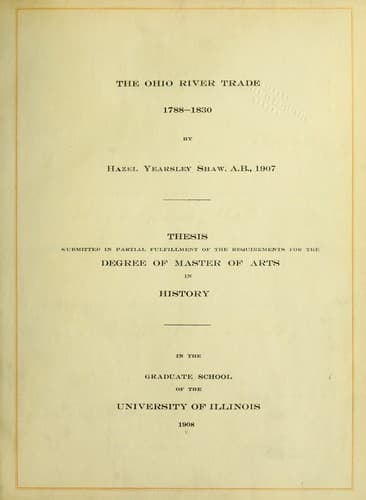
The Ohio River Trade, 1788-1830Shaw, Hazel Yearsley
History
The Ohio River Trade, 1788-1830
Shaw, Hazel Yearsley
Ohio River -- History; Ohio River Valley -- History
The "Fame" from Pittsburg, arrived in Cincinnati, in 1827 with a
cargo, part of which consisted of 102 pieces of cannon, and and
about 80 tons of grape shot, for the United States Navy. Her deck
was entirely filled with empty hogsheads and casks, belonging to a
house in Pittsburg, sent to New Orleans to be filled with a return
cargo of Molasses, as it was found to be much cheaper to have the
casks made at Pittsburg and pay their freight to New Orleans, than
to purchase them at the latter place.[471] In 1828, 5504 bales of
Kentucky cotton bagging, 15,526 coils of bale rope, and 4,918,494
lbs. of lard, were received in New Orleans, as against 2,308 bales,
1 0,459 coils, and 2,426,299 lbs. of the preceding year.[472]
New Orleans had drawn away considerable of the trade of the western
country with Philadelphia and Baltimore. Basil Hall says, "There
are projects afloat, however, for restoring this lost balance to
Philadelphia and Baltimore, and of regaining some portion of the
profits derived from supplying the western country with goods, and
of drawing off its produce.... If the mouth of the Mississippi
could be damned up, or the harbor of New York demolished, there
might be some chance for the resuscitation of the intermediate
seaports."[473] Grain, salted meats, spirits, tobacco, hemp, skins,
and the fruits of the regions bordering on the Missouri, Ohio,
and Mississippi were sent to New Orleans;[474] return cargoes of
manufactured goods from foreign countries, together with fish,
salt, sugar, steel, iron, and other articles were sent back by
steamboat.[475] Slaves were sent from Maryland, Virginia, and
Kentucky to the southern states bordering on the Mississippi and
the Gulf of Mexico. Basil Hall says, "During certain seasons of the
year, I am informed, all the roads, steamboats, and packets are
crowded with negroes on their way to the great slave markets of the
South."[476]
During the year 1828, 4100 hogsheads of sugar, and 3500 barrels or
bags of coffee were received at Louisville, worth together about
$600,000. In 1825-1826, 2050 hogsheads of tobacco were deposited at
Louisville; 4354 in 1826-1827; and 4075 in 1827-1828. Freight was
so reduced by competition, that sugar, coffee, tea, and groceries
in general, had only a small advance over their prices in New
Orleans, Philadelphia, and Baltimore. Good sugar of the new crop
sold in Louisville at 7¼ to 7½ cents per pound, by the single
barrel.[477]
Public-domain text, read in full here on John Shaqi.
Reviews
Reviews
No reviews yet
Be the first to share your thoughts on this work.
Elsewhere in the archive
Join the Discussion
Join the discussion
Sign in to leave a comment or review.
Sign InorCreate an account