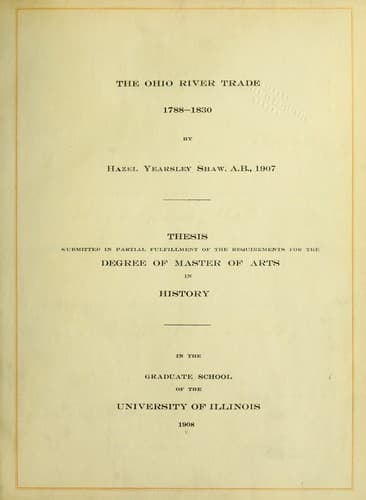
The Ohio River Trade, 1788-1830Shaw, Hazel Yearsley
History
The Ohio River Trade, 1788-1830
Shaw, Hazel Yearsley
Ohio River -- History; Ohio River Valley -- History
Cincinnati, but a small and unimportant village before 1811,
suddenly sprang into prominence during this period and even
threatened to become the serious rival of Pittsburg. The
manufacturing industry contributed largely to the growth of this
town. In 1814 the 'Register' speaks of Cincinnati as being "the
busiest town in Ohio, and except Pittsburg, and Lexington, the
greatest place of manufacturing in the western country."[544] In 1826
the manufacturing industry of this city amounted to $1,800,000, not
more than fifteen steam engines being employed in manufactures.[545]
In 1830 the 'Register' speaks of this city as follows: "Cincinnati,
'the queen of the West' goes on rapidly to increase in population
and wealth. Her happy location is made the most of by industrious
and enterprising freemen. Manufactures abound, and a spirit of
improvement prevails. Labor is honored, and profits are constantly
added to capital. This city seems long since to have recovered from
the effects of certain spe culations which, for a considerable
time, checked its advancement."[546] Iron articles and cabinet
furniture were the chief articles of manufacture exported from
the city.[547] The making of sugar mills for Louisiana and the West
Indies formed a large business at Cincinnati, and also at Pittsburg
and Wheeling.[548]
The trade, especially the exports, formed a very large element
of the business of Cincinnati. Birkbeck, writing in 1818, says,
"Cincinnati is, however, a most thriving place, and backed as it
is already by a great population and a most fruitful country, bids
fair to be one of the first cities of the West. We are told, and
we cannot doubt the fact, that the chief of what we see is the
work of four years. The hundreds of commodious, well furnished
brick houses; the spacious and busy markets; the substantial public
buildings; the thousands of prosperous well dressed, industrious
inhabitants; the numerous wagons and drays; the gay carriages;
the shoals of craft; the busy stir prevailing everywhere, ..."[549]
all testify to the prosperity of the city. Pork formed the chief
article of export.[550] The 'Register' in 1827, says, "The pork
business of this city is equal if not of greater magnitude, than
that of Baltimore, and is, perhaps, not exceeded by that of any
place in the world.[551] The exports of Cincinnati in 1820 were
worth about $1,000,000, including both manufactures and other
articles.[552] The opening of the Miami Canal increased the trade
of Cincinnati, by making it the place of deposit for the produce
exported from the surrounding country.[553] In 1812 the sale of
imported articles amounted to $250,000 per year;[554] about 1830
the imports, of which dry goods formed the principal item, were
estimated to be worth five million dollars.[555]
The population of Cincinnati in 1815 was 6,498;[556] in 1826,
16,230;[557] and in 1830, 25,279.[558]
Public-domain text, read in full here on John Shaqi.
Reviews
Reviews
No reviews yet
Be the first to share your thoughts on this work.
Elsewhere in the archive
Join the Discussion
Join the discussion
Sign in to leave a comment or review.
Sign InorCreate an account