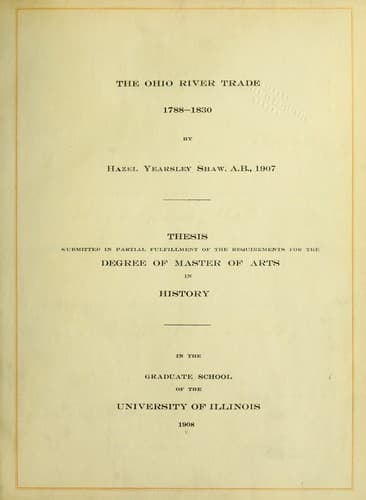
The Ohio River Trade, 1788-1830Shaw, Hazel Yearsley
History
The Ohio River Trade, 1788-1830
Shaw, Hazel Yearsley
Ohio River -- History; Ohio River Valley -- History
Louisville derived her greatest advantage from the river trade.
Before the building of the canal, goods brought down the river,
had to be unloaded here and carried around the Falls.[559] The steam
boat commerce of this city amounted in 1820 to 29,014 tons.[560]
The wealth of Louisville was employed chiefly in the importation
of merchandise from New Orleans, and the eastern cities, and
the shipment of western produce to the Southern and Atlantic
markets.[561] Manufactures were developed to some extent.[562] The
population increased from 1350 in 1810, to 10, 336 in 1830.[563]
Marietta had, in the early period, engaged quite extensively in the
ship building industry, which declined from about 1807 to 1816,
when it was revived again.[564] In 1814 this town was engaged in
manufacturing and carried on quite a brisk trade,[565] but Ogden, in
1821, says that it was rapidly declining.[566]
Wheeling derived much advantage from her location, being situated
at a point where the Ohio was navigable at all seasons. It was
the principal depot for the supply and commerce of that part of
Virginia in 1819,[567] and in 1823 enjoyed considerable importance on
account of the great quantity of merchandise brought to and from
the Ohio along the National Road.[568] Boat building was carried on
to some extent in Wheeling. By 1829 this town had engaged quite
extensively in manufactures.[569]
Steubenville, Ohio, was the market for the produce of the
surrounding country, which it supplied with English and West
India goods.[570] As early as 1815 this town began to establish
manufactories,[571] and in 1825 was exporting many thousand dollars
worth of cloth to the Atlantic States.[572] In 1817 the city
contained 2032 inhabitants,[573] and in 1830, 3153.[574]
Maysville, Kentucky, was the principal river port for the
northeastern part of the State.[575] The greater part of the goods
from Philadelphia and the eastern cities were landed here, and
distributed over the state.[576]
Vincennes, Indiana, served as a place of extensive supply of
merchandise to the interior of that state.[577] Vevay, Indiana,
was also quite a commercial town.[578] Zanesville, Ohio, became a
thriving town, engaged in manufactures[579] and trade.[580]
Shawneetown, Illinois, enjoyed a share in the trade on the
river.[581]
These river towns developed and increased in importance as the
river trade became an ever increasing object of importance.
Pittsburg and Cincinnati were by far the two greatest commercial
and manufacturing centers of this western country during the years
1811-1830. As this great stream of emigrants poured into the West,
the soil was brought into cultivation, and its surplus produce
exchanged for articles of home and foreign manufacture.
FOOTNOTES:
[487] Flint, T., History and Geography, I., 387.
[488] Ibid., I., 178.
Peck, J. M., Annals, 651-652.
[489] Flint, T., History and Geography, I., 178.
[490] Ibid., I., 172.
[491] Flint, T., History and Geography, I., 178.
Public-domain text, read in full here on John Shaqi.
Reviews
Reviews
No reviews yet
Be the first to share your thoughts on this work.
Elsewhere in the archive
Join the Discussion
Join the discussion
Sign in to leave a comment or review.
Sign InorCreate an account