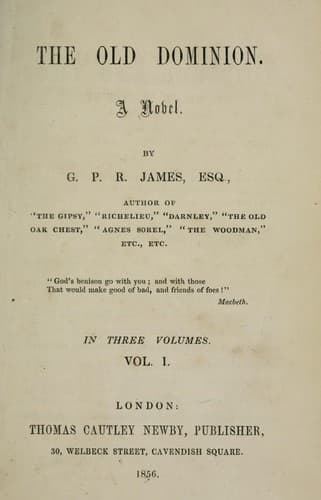
The Old DominionJames, G. P. R. (George Payne Rainsford)
General
The Old Dominion
James, G. P. R. (George Payne Rainsford)
Southampton Insurrection, 1831 -- Fiction
"Stop a minute," he answered; "that is not exactly a fair statement of
the question. Each State has its reserved rights. It gives up to the
federal government the decision of certain questions affecting the
interests of the whole Union. Its domestic laws and institutions it
reserves entirely for its own decision. The North--I am a Northern man
you must remember--seeks to violate this compact, upon which the whole
Union depends, and wages war--for it is a moral warfare--against the
South, upon the institution of slavery. That institution is, in fact,
the battleground. The South occupies it, and says,--'It is mine. You
shall not drive me from it. It is true, I care very little for this
debatable ground, and may hereafter, in my own good time, give it up
as a thing not worth contending about; but I will not give it up to
force; and on this ground I will fight you; for if you carry this
aggression by my imbecility or indolence, no one can tell where you
will attack me next. In regard to your abstract doctrines, you may be
right or you may be wrong; but with regard to your interference with
my domestic affairs, you are decidedly wrong; and that I will not
tolerate.' In short, my good friend, whatever the North has done, and
whatever the North may do, in this sense, only tends to rivet the
chains on the hands of the negro more firmly than before. It may seem
very absurd, but such is human nature; and although I admit that in
many of the arguments used by the abolitionists, and even by this man,
McGrubber, to-night, there is a great deal of force, yet their
strength is changed to weakness when men become convinced, as every
Southern man is, that they are used for political, factious, and
partisan purposes. You cannot have a domestic police in such a union
as this; and every man will whip his own children in his own house,
when he thinks they deserve it."
"Although I judged it rash and most dangerous," I answered, "to preach
such doctrines as we have heard to-night to a large crowd of negroes,
yet I could not help thinking that many of Mr. Mc Grubber's arguments
were exceedingly specious, if not cogent: that little apologue of his,
for instance, of the white slave in Barbary and his liberation. It
struck me as a very happy illustration of his views."'
Public-domain text, read in full here on John Shaqi.
Reviews
Reviews
No reviews yet
Be the first to share your thoughts on this work.
Elsewhere in the archive
Join the Discussion
Join the discussion
Sign in to leave a comment or review.
Sign InorCreate an account