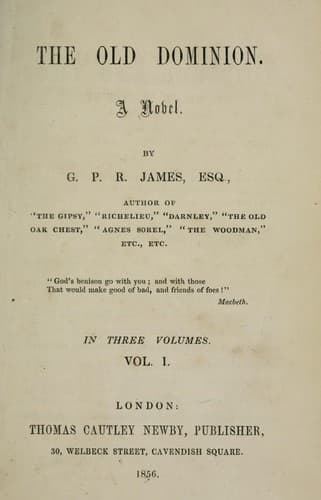
The Old DominionJames, G. P. R. (George Payne Rainsford)
General
The Old Dominion
James, G. P. R. (George Payne Rainsford)
Southampton Insurrection, 1831 -- Fiction
"A cunning piece of rhetoric," answered my acute friend, "peculiarly
illustrative of the rhetoric of fanatics. Do you not remark that
whenever they have a point to carry, they employ a figure, and in that
figure they pre-suppose a complete parity between two really
dissimilar cases. Knock away the _petition principia_, and what do you
find? Here he places a white man, always accustomed to freedom, and
with all the intellectual qualities impliedly cultivated by a white
man's education, with a white man's wants, wishes, habits, and
feelings, exactly upon a par with a negro born upon a plantation,
habituated from infancy to slavery, without a thought, a desire, or a
notion beyond the state in which he was brought up, except such as may
have been instilled into him by abolitionists. Is this fair to begin
with? Is there a parity between the two cases? Then again, the white
man in flying from the bonds which had been accidentally imposed upon
him, returns to home, to his ancient habits, to the free use of
faculties and endowments which are sure, if rightly employed, to lead
to competence, if not to wealth, to independence, and to ease. The
negro flying from his master, on the contrary, leaves family and
friends, old habits and associations, food, care, and protection in
sickness or old age, for a wide, unfriended, uncertain, future, where
there is nothing probable but long-protracted labour, unbefriended
sickness, unpitied decrepitude, and death on a dunghill. His nominal
independence is shackled by the continual necessity of seeking food by
labour; and his freedom becomes a curse instead of a blessing, in
consequence of the prejudices of colour and caste. Is there any parity
between these two cases? I declare I would a great deal rather be a
slave to the hardest master I have ever seen in Virginia--and I have
now been here many years--than I would be a free negro in an abolition
state. But this was all rhetoric, mere rhetoric, the most cowardly and
contemptible of all species of sophistry. Much better to say boldly,
'You have no right to reduce any man to slavery--you shall not do evil
that good may come of it--the Declaration of Independence says, that
all men are created equal; they are endowed by their Creator with
certain inalienable rights; among these are life, liberty, and the
pursuit of happiness. By holding any man in slavery, whatever be his
colour, you violate this first great principle of the American
constitution, you break the solemn pact upon which this union was
founded, by which alone she claimed, maintained, and accomplished her
independence of Great Britain.' Better to say this, and fight it out
upon this ground, than go sneakingly to work to get petty advantages
in Congress, or criminally strive to render the slaves discontented
with their masters. I have come to the conclusion, my dear Sir
Richard, that the abolitionists are the very worst enemies of the
slaves themselves, who, after all, are but mere----"
Public-domain text, read in full here on John Shaqi.
Reviews
Reviews
No reviews yet
Be the first to share your thoughts on this work.
Elsewhere in the archive
Join the Discussion
Join the discussion
Sign in to leave a comment or review.
Sign InorCreate an account