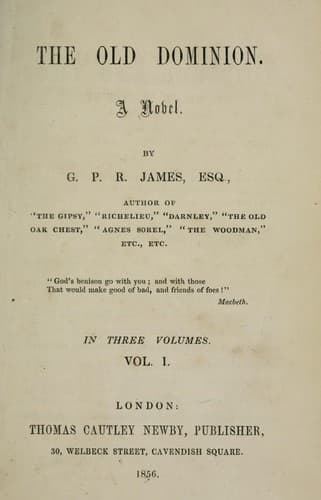
The Old DominionJames, G. P. R. (George Payne Rainsford)
General
The Old Dominion
James, G. P. R. (George Payne Rainsford)
Southampton Insurrection, 1831 -- Fiction
Picking up a novel by the historical novelist G. P. R. James, with
Virginia as subject and "The Old Dominion" for title, one inevitably
expects a romance about Elizabethan adventures and noble savages,
something after the manner of Fenimore Cooper, with an air of greater
antiquity. What, then, is our surprise to find that the veteran
romancer has given us a novel of recent history, with facetious
sketches of Yankee oddities, a plot based on a legal _imbroglio_, and
a painstaking study of that perennial problem, the negro question.
"The Old Dominion" is, in fact, James's "American Notes" and "Martin
Chuzzlewit," though the portraiture is altogether kindly, and the
satire of the mildest kind. He has observed the life and manners of
the country where he resided as British Consul with the same minute
care as that which he lavishes on his historical studies. Without
Dickens's virulent and entertaining comedy, the picture of life in
Virginia in the thirties is probably far truer because of this
scrupulous accuracy, and because of the moderation and patient
endeavour to decide justly upon disputed points. Years before "Uncle
Tom's Cabin," James gave the English public this thoughtful picture of
slavery. He is not one-sided. He rather discloses at once the evils of
slavery and the difficulties of emancipation in a purely imaginative
way without pleading strongly for a remedy. He shows powerfully what a
terrible retribution has been brought upon the land by those who
introduced slavery. The negro's insane ferocity when freed from
control, and the peril of a small white population at the mercy of a
host of revolted slaves, are brought out in the history of the negro
insurrection, which is traced from its origin in the preaching of
McGrubber and the misguided brooding of Nat Turner, down to its
repression. The hero and heroine and the love romance, with its
profusion of obstacles to happiness, are the familiar ones, with a
modern instead of a medi[ae]val environment. But the vivacity of the
style is quite unusual. Mr. Byles is epigrammatic with his three
distinctions between the North and the South. "In the South they fight
duels whenever they can, have slaves for their servants, and grow
tobacco and corn. In New England they never fight if they can help it,
are slaves to their own servants, and make wooden clocks and wooden
nutmegs." And our serious romancer even ventures on a broad joke quite
frequently.
THE OLD DOMINION.
CHAPTER I.
Public-domain text, read in full here on John Shaqi.
Reviews
Reviews
No reviews yet
Be the first to share your thoughts on this work.
Join the Discussion
Join the discussion
Sign in to leave a comment or review.
Sign InorCreate an account