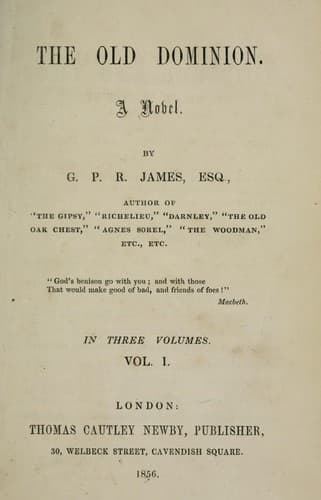
The Old DominionJames, G. P. R. (George Payne Rainsford)
General
The Old Dominion
James, G. P. R. (George Payne Rainsford)
Southampton Insurrection, 1831 -- Fiction
"This man's son!" exclaimed Mr. Thornton. "We never heard of that, and
never received any answer to the first letter--perhaps it was
intercepted. However, Mr. William Thornton almost immediately took out
letters of administration to Colonel Thornton's property, as his next
of kin--although your aunt had so long enjoyed undisputed possession.
He has since, with the aid of this hopeful son of his, been fencing
himself in with all sorts of legal forms and quibbles--has got
possession of the negroes, let the old house and plantation, and is
now, we understand, moving the legislature to escheat the property and
grant it to him; the heirs being, as he declares, aliens."
"But does your law sanction such doings?" I asked.
"It sanctions a good many things that it should not sanction," replied
Mr. Thornton; "and these matters of escheat and administration are so
loosely managed here, that the property of persons dying without
relations actually on the spot is an object of speculation and a means
of livelihood to half the rogues in the state. Thank God, my dear
young friend, you are here at last; for it is not too late yet to stop
this iniquitous affair, though he has sold all the cattle and all the
horses, which is a dead loss, I suppose."
"But can he not be made accountable?" I inquired.
Mr. Thornton smiled.
"There are two sorts of banks," he answered, "from one of which you
can draw money, from the other nothing but pebblestones. Now, Mr.
William Thornton's bank is of the latter quality. The court required
security, it is true, when they granted the letters of administration,
but took men who are more deeply bankrupt than himself. That is the
way we manage things in Virginia, especially when the people who are
really interested do not appear to take care of their own property."
"But, my dear sir," I replied, "it was impossible. I was in India with
my regiment. As some battles were coming on--expected every day--it
was impossible either to ask for leave of absence or to sell out,
until the war was at an end. As soon as that occurred, I _did_ sell
out; for the climate did not agree with me. I got bilious, and
home-sick, and moody; disliked pillaus, abominated rice, and could not
bear curry; was thoroughly disgusted with pale ale and claret, and
thought Allahabad's sun the most unpleasant gentleman that ever rode
the sky. Besides, I did not know what my aunt had left me. It might
have been nothing but an old farthingale, for aught I knew to the
contrary."
Public-domain text, read in full here on John Shaqi.
Reviews
Reviews
No reviews yet
Be the first to share your thoughts on this work.
Join the Discussion
Join the discussion
Sign in to leave a comment or review.
Sign InorCreate an account