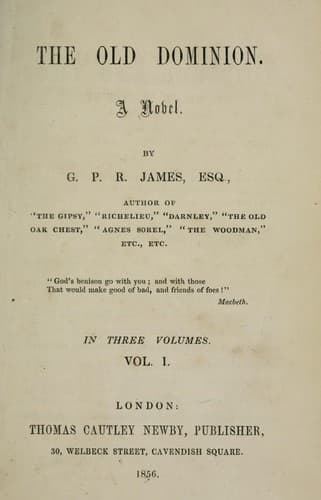
The Old DominionJames, G. P. R. (George Payne Rainsford)
General
The Old Dominion
James, G. P. R. (George Payne Rainsford)
Southampton Insurrection, 1831 -- Fiction
"I fear my aunt will make herself ill with this jaunt," said Miss
Davenport, evidently a little desirous of changing the conversation.
"She is in very delicate health. Does it not strike you, Sir Richard,
that American ladies are very weakly creatures, compared with
Englishwomen? I must make an exception in my own favour; for Aunt Bab
used to make me walk five or six miles a day, or ride, or skip, or
take one sort of violent exercise or another during half of my time.
In everything else I was quite a spoiled child; but in this she was
inexorable, and I am reaping the benefit of it now."
"I have, indeed, remarked," I said, "that the ladies of this country
are not so strong as those of Europe; but I cannot help thinking that
the climate is more enervating."
"Not a bit of it," she cried; "that is one of your prejudices again, I
am sure. We get feeble and delicate because we take no exercise, and
live altogether in a sort of artificial manner. It is worse in the
South than in the North a great deal, because here, with the multitude
of servants we have, a southern girl hardly learns the use of her feet
or her hands. The only time for exercising the first is at a ball, and
the second when she plays on the piano. She gets up in the morning,
and sits down in an armchair, and says, 'Julia, bring me my slippers;
Susannah, comb my hair;' and so the whole day goes on. Climate has
nothing to do with it. It is want of free air and proper exercise; bad
hours, and all that sort of thing. We are up here, uncle," she
continued speaking to Mr. Thornton, who was calling to know where we
were; and in a moment after, the whole party were reassembled.
We then walked over the house, visited the stables and outbuildings,
and made a tour through the negro cabins, which lay at a little
distance behind.
The condition, mode of life, and treatment of the negro population in
the country, were of course subjects of great interest to me, and as
these were the first rural slaves I had seen, I asked a good many
questions, in which Mr. Thornton aided and joined me. All the people
seemed happy and contented--at least there was nothing to show the
contrary; yet, in one or two cases--amongst some of the younger men
especially--I imagined I perceived a sort of reserve--a holding back
of their thoughts, as if they were either unwilling or afraid to speak
out boldly.
I called Mr. Thornton's attention to this fact, as we turned back
towards the house; and he replied,--
Public-domain text, read in full here on John Shaqi.
Reviews
Reviews
No reviews yet
Be the first to share your thoughts on this work.
Join the Discussion
Join the discussion
Sign in to leave a comment or review.
Sign InorCreate an account