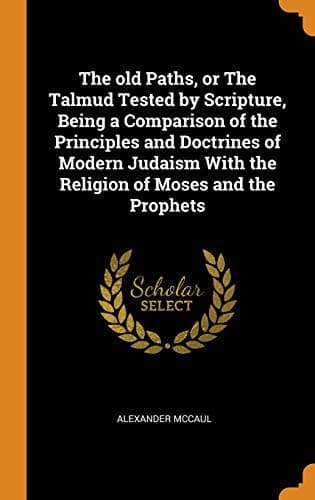
The old paths, or the Talmud tested by Scripture: Being a comparison of the principles and doctrines of modern Judaism with the religion of Moses and the prophetsMcCaul, Alexander
Religion
The old paths, or the Talmud tested by Scripture: Being a comparison of the principles and doctrines of modern Judaism with the religion of Moses and the prophets
McCaul, Alexander
Judaism -- Works to 1900
“Rome, which led us away captive, is of the seed of Kittim, and so the
Targumist has said, in Numbers xxiv. 24, ‘And ships shall come from the
coast of Kittim.’ And this is the same as the Greek monarchy, as I have
explained in the book of Daniel; and there were very few who believed on
the man of whom they made a god. But when Rome believed in the days of
Constantine, who changed the whole religion, and put an image of that
man upon his standard, there were none in the world who observed the new
law except a few Edomites, therefore Rome is called the kingdom of
Edom.” (Comment. on Gen. xxix.) We do not now stop to refute the false
statements which Aben Ezra here makes. Every one that knows anything of
history, knows that in less than a century after the time of Jesus of
Nazareth, the Christian religion had made great progress in the whole
Roman empire, and that the propagation of the new law, as Aben Ezra
calls it, before the time of Constantine, was more rapid and more
extensive than after his conversion. Our business at present is with his
interpretation of the word Edom; he says plainly that Edom and Edomites
mean the Christians. Now let us hear Abarbanel:—
ומזה תדע שלא לבד על ארץ אדום הסמובה לא׳׳י נבא הנביא כ׳׳א גם על האומה
שנסתעפה משם ונתפשטה בכל העולם והיא אומת הנוצרים היום הזה שהם מבני אדום ׃
“From this you may learn that the prophet (Obadiah) did not prophesy
only against the land of Edom, which is in the neighbourhood of the land
of Israel, but also against that people which branches off from thence,
and is spread through the whole world, and that is the people of the
Christians in this our day, for they are of the children of Edom.”
(Comment. on Obadiah.) Here, then, we have Maimonides, Kimchi, Aben
Ezra, and Abarbanel, all giving the same interpretation, and all
asserting that Edom means the Christians. According to this
interpretation, then, the above dreadful imprecations are for the
destruction of the Christians. Is this tolerant or charitable? Is this
in accordance with Moses’ account of the Divine character—“Merciful and
gracious, long-suffering, and abundant in goodness and truth?” Are these
the petitions that poor sinful creatures ought to offer when they
assemble for the worship of the Creator of all flesh? Above all, are
they suitable in an English synagogue, and in the present day? You may
say that Kimchi and those other commentators, lived in the times of
Popery, and that Edom only means the Roman Catholic Christians. But what
will those Jews say who live in Rome itself, and France, and Bavaria,
and other Roman Catholic countries? You may think them in error, so do
we, but we cannot for that pray that God “would satiate the clods with
their blood, manure the earth with their fat, and cause the stench of
their carcases to ascend.” We could not utter such an imprecation
against the cannibals of New Zealand, nor the man-stealers of Africa.
But if you say that you do not offer up these petitions against the
Public-domain text, read in full here on John Shaqi.
Reviews
Reviews
No reviews yet
Be the first to share your thoughts on this work.
Elsewhere in the archive
Join the Discussion
Join the discussion
Sign in to leave a comment or review.
Sign InorCreate an account