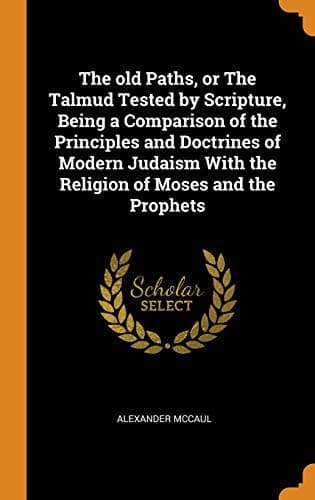
The old paths, or the Talmud tested by Scripture: Being a comparison of the principles and doctrines of modern Judaism with the religion of Moses and the prophetsMcCaul, Alexander
Religion
The old paths, or the Talmud tested by Scripture: Being a comparison of the principles and doctrines of modern Judaism with the religion of Moses and the prophets
McCaul, Alexander
Judaism -- Works to 1900
“_Behemoth_ is the name of a great beast. In the habitable world there
is not a greater than it. The reason why the words ‘_with thee_’ are
added, is, that it is a land animal, and at the end he mentions
Leviathan, which is an animal of the sea. But some say the meaning of
‘with thee’ is, that the beasts were created on the same day with the
first Adam; but this interpretation is after the manner of a drash.”
(Aben Esra in loc.) This passage not only gives Aben Esra’s opinion as
to the real existence of Behemoth, but shows that other commentators, to
whom he alludes, were of the same mind. Rashi not only asserts the
existence, but says plainly, בהמות מוכן לעתיד, “Behemoth, that is
prepared for the time to come.” And again, in his commentary on Psalm l.
10, he takes the words בהמות בהררי אלף, which we translate, “The cattle
upon a thousand hills,” as referring to “Behemoth upon a thousand
hills,” and says—
הוא המתוקן לסעודת העתיד שהוא רועה אלף הרים ליום וכל יום ויום צומחים ׃
“This is he that is prepared for the banquet of the time to come, for he
eats up the produce of a thousand hills in one day, and every day they
grow again.” The context of these words evidently show that Rashi, the
most popular, and the most read of all the Jewish commentators, looked
for a real, not an allegorical, feast upon the flesh of the Leviathan
and Behemoth. The preceding and following words speak not of
allegorical, but of real cattle and fowls. According to Rashi, the whole
passage would read thus:—“I will take no bullock out of thy house, nor
he-goats out of thy folds. For every beast of the forest is mine, and
Behemoth upon a thousand hills. I know all the fowls of the mountain,”
&c. Here, then, Behemoth is introduced amongst real animals all fit for
food, so that it is impossible to take it figuratively. This animal is
also suitable in size for so great an entertainment; he consumes the
produce of a thousand mountains every day. This was also the opinion of
Jonathan, for in his Targum on the fiftieth Psalm he has paraphrased the
tenth verse as follows:—
ארום דילי כל חיות חורשא ועתדת לצדיקיא בגן עדן בעיריא דכין ותור בר דרעי
בכל יומא בטורין אלפא ׃
“For every beast of the wood is mine, and I have prepared for the
righteous in Paradise pure cattle, and the wild ox, that feeds every day
upon a thousand mountains.” All these testimonies (and many more might
be added) plainly prove, that the Jews, in times past, looked for a real
and substantial feast upon Leviathan and Behemoth; and when we remember
that the commentary of Rashi is the first that is put into the hands of
the Jewish youth all over the world, and that it is generally regarded
as almost, if not altogether, inspired, it is easy to conclude what is
the opinion of the great majority of Jews, even in the present day, as
to this entertainment. Maimonides, indeed, denies that there will be any
eating and drinking in the world to come. He says—
Public-domain text, read in full here on John Shaqi.
Reviews
Reviews
No reviews yet
Be the first to share your thoughts on this work.
Elsewhere in the archive
Join the Discussion
Join the discussion
Sign in to leave a comment or review.
Sign InorCreate an account