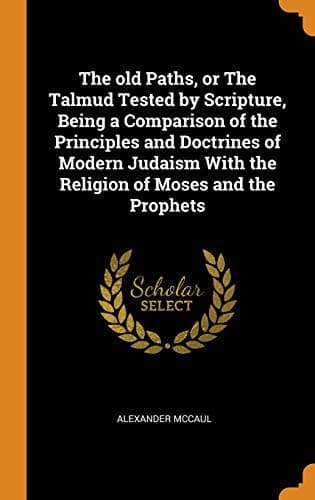
The old paths, or the Talmud tested by Scripture: Being a comparison of the principles and doctrines of modern Judaism with the religion of Moses and the prophetsMcCaul, Alexander
Religion
The old paths, or the Talmud tested by Scripture: Being a comparison of the principles and doctrines of modern Judaism with the religion of Moses and the prophets
McCaul, Alexander
Judaism -- Works to 1900
The same may be said of the necromancers, who obtain no
answer on the Sabbath-day. It is nothing more than a clever fiction. By
the law of Moses necromancy is forbidden to the Jews, and therefore the
inventor well knew that no pious Jew would ever make the experiment,
either on the Sabbath or the other days. The story of Turnus Rufus, and
his father, as told in the Bereshith Rabba, is plainly contrary, even to
the assertions of the oral law itself. The father is made to say,
“Whosoever will not keep the Sabbath voluntarily in your world, must
keep it here, in spite of himself;” which implies that all, who do not
keep the Jewish Sabbath, must be punished in the flames of hell; whereas
the oral law says that the observance of the Sabbath is not required of
the sons of Noah. When this prayer was introduced into the Liturgy of
the synagogue we know not, but there it now stands, and in one short
paragraph contains three downright falsehoods. David Levi himself points
us to R. Akiva as the author of the last two; and accordingly the Talmud
records the original reference to the business of the necromancers and
the river Sambation, as proceeding from the mouth of that great Rabbi.
This brings us back to the time immediately succeeding the rejection of
Jesus of Nazareth, and shows us the superstition and the falsehood of
those who rejected him. Either R. Akiva invented these things himself,
and then he is guilty of deliberate falsehood, or he received these
accounts from others who went before him, and then he was a
superstitious man, and the guilt of inventing falsehood is thrown back
on the earlier rabbies. What is to be thought then of the wisdom of
those men who were weak enough to believe, or wicked enough to invent,
such absurd fables? Yet these are the men who opposed Christianity, and
this is the system which a large portion of the Jewish nation has
preferred for 1700 years. That the Rabbinical Jews have firmly believed
these legends is plain. They occur in the Talmud, whose authority is
regarded as divine. They are repeated by Rashi, Ramban, Bechai, and a
whole host of the most esteemed Jewish writers. They have formed a part
of the synagogue service for centuries, and are still found in the
Prayer-books of the English Jews, to testify that they are not yet
emancipated from the chains of superstition. If they had been, if any
considerable number of Jews had been convinced of the falsehood of these
stories, they would never have suffered them to remain in the worship of
God. It is utterly impossible to suppose that men would sanction the
solemn propagation of falsehood, and yet whenever the Pentecost prayers
are read or printed, there the fables of Behemoth and Leviathan, Adam
and the Sabbath, Turnus Rufus and the Sambation, are solemnly accredited
to the world as worthy of all belief and honour. The fact that they
constitute a part of a solemn address to Almighty God, and that not from
Public-domain text, read in full here on John Shaqi.
Reviews
Reviews
No reviews yet
Be the first to share your thoughts on this work.
Elsewhere in the archive
Join the Discussion
Join the discussion
Sign in to leave a comment or review.
Sign InorCreate an account