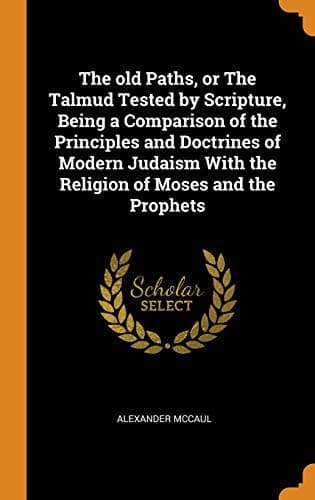
The old paths, or the Talmud tested by Scripture: Being a comparison of the principles and doctrines of modern Judaism with the religion of Moses and the prophetsMcCaul, Alexander
Religion
The old paths, or the Talmud tested by Scripture: Being a comparison of the principles and doctrines of modern Judaism with the religion of Moses and the prophets
McCaul, Alexander
Judaism -- Works to 1900
“All that stood on Mount Sinai were sanctified and purified, and were
healed from every blemish, even the blind and the lame that then
happened to be in Israel, as is taught in Siphri.” In this part of the
fable the inventors of the oral law endeavour to flatter the vanity of
the Israelites, and thus to engage their affections in behalf of that
tradition which was to secure their own power. The Scribes understood
well the deceitfulness of the human heart, and knew that men love to
hear and are ready to believe any thing that tends to their own
personal aggrandizement. But in thus flattering the people, they were
turning their backs upon that example which Moses set them; and
contradicting the whole current of Scripture testimony. Moses and the
prophets, as the servants of God, told the people of their sins and
their evil deeds, that they might repent and be saved. Their object
was not to secure popular favour, nor to advance their own selfish
purposes; they therefore could afford to be honest and to speak truth.
The inventors of the oral law, on the contrary, were endeavouring to
erect a fabric of personal honour and power: they were therefore
obliged to address themselves to the weak side of the human heart; and
in doing so, were compelled to run counter to the plainest
declarations of God’s Word. All men and every nation like to be told
that they are superior to the rest of the world, and are distinguished
by moral endowments from the mass of mankind. The inventors of the
oral law, therefore, told Israel that they were far elevated above all
other nations, for they had been cleansed at Sinai from that innate
defilement which still contaminates all the rest of the children of
men. But is this true—is this what Moses and the prophets say? Moses
says, “Understand, therefore, that the Lord thy God giveth thee not
this good land to possess it for thy righteousness: for thou art a
stiff-necked people.” “Ye have been rebellious against the Lord from
the day that I knew you.” (Deut. ix. 6, 24.) Isaiah says of Israel,
“From the sole of the foot even unto the head there is no soundness in
it, but wounds, and bruises, and putrifying sores.” “Ah! sinful
nation!—a people laden with iniquity; a seed of evil-doers—children
that are corrupters.” (Isaiah i. 4-6.) And again he says, “Woe is me,
for I am undone: because I am a man of unclean lips, and I dwell in
the midst of a people of unclean lips.” (Isaiah vi. 5.) Jeremiah says,
“Can the Ethiopian change his skin and the leopard his spots? Then may
ye also do good that are accustomed to do evil.” (Jer. xiii. 23.) And
again, “All these nations are uncircumcised, and all the house of
Israel are uncircumcised in the heart.” (Jer. ix. 26.) The Lord
himself says to Ezekiel, “Son of man, I send thee to the children of
Israel, to a rebellious nation that hath rebelled against me: they and
their fathers have transgressed against me to this very day. For they
are impudent children and stiff-hearted.” (Ezek. ii.
Public-domain text, read in full here on John Shaqi.
Reviews
Reviews
No reviews yet
Be the first to share your thoughts on this work.
Elsewhere in the archive
Join the Discussion
Join the discussion
Sign in to leave a comment or review.
Sign InorCreate an account