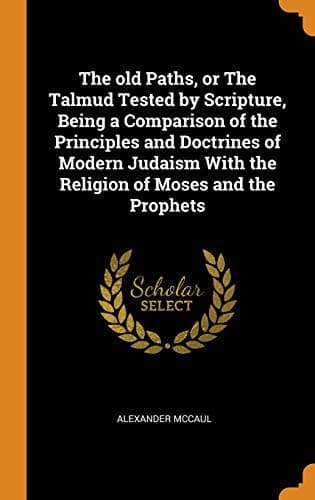
The old paths, or the Talmud tested by Scripture: Being a comparison of the principles and doctrines of modern Judaism with the religion of Moses and the prophetsMcCaul, Alexander
Religion
The old paths, or the Talmud tested by Scripture: Being a comparison of the principles and doctrines of modern Judaism with the religion of Moses and the prophets
McCaul, Alexander
Judaism -- Works to 1900
“Rabbi Johannan says, none were allowed to sit in the Sanhedrin, who
were not men of stature, men of wisdom, men of good appearance, aged,
skilled in magic, and acquainted with the seventy languages, so that the
Sanhedrin might not be obliged to hear through an interpreter.”
(Sanhedrin, fol. 17, col. 1.) In this short extract there are several
fables—first, that all the members of the Sanhedrin should be skilled in
magic, or magicians, is plainly contrary to the express command of God,
who says, “There shall not be found among you any one that maketh his
son or his daughter to pass through the fire, or that useth divination,
or an observer of times, or an enchanter, or a witch מכשף—for all that
do these things are an abomination unto the Lord: and because of these
abominations the Lord thy God doth drive them out from before thee.”
(Deut. xviii. 10-12.) This command of God makes no exception in favour
of the members of the Sanhedrin. It absolutely forbids any such in
Israel for any purpose. The commentary indeed tells us, that this
magical skill was required in self-defence.
להמית מכשפים הבוטחים בכשפיהם להנצל מידי בית דין ׃
“In order to kill the magicians who trusted in their magical arts to
deliver them out of the hands of the tribunal.” But this explanation
does not mend the matter. Magic is a thing absolutely unlawful and
expressly forbidden by God. It was therefore unlawful either to learn or
to practise it, even for the purpose of killing a magician. If the plea
of self-defence or necessity made it lawful for the Sanhedrin to learn
magic, the same argument would justify it doubly in the case of the
people, who were more likely to be the objects of the magician’s
attacks; for surely these persons would be careful to avoid all contact
with the members of the Sanhedrin, whom they knew to be more than a
match for them in the black art. According to this method of arguing all
Israel might have been skilled in magic, though the law requires that
not one such person should be found among them. Either then this account
is absolutely false, or the members of the Sanhedrin were bad men, who
learned what was expressly forbidden by the law of God; and in either
case, the Talmudic accounts of this tribunal are unworthy of credit.
But it may well be doubted whether the members of this great council
confined their magical exercitations to the killing of magicians. We
find elsewhere, if the Talmud speak truth, that the rabbies at least
made other magical experiments, and have even recorded the means which
they employed, for the benefit of posterity.
Public-domain text, read in full here on John Shaqi.
Reviews
Reviews
No reviews yet
Be the first to share your thoughts on this work.
Elsewhere in the archive
Join the Discussion
Join the discussion
Sign in to leave a comment or review.
Sign InorCreate an account