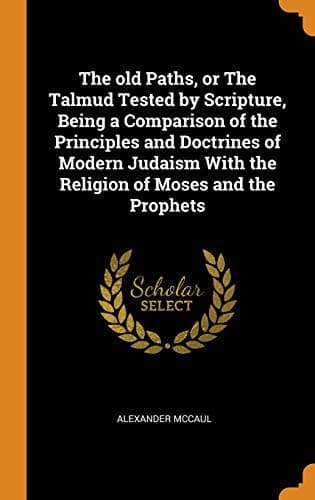
The old paths, or the Talmud tested by Scripture: Being a comparison of the principles and doctrines of modern Judaism with the religion of Moses and the prophetsMcCaul, Alexander
Religion
The old paths, or the Talmud tested by Scripture: Being a comparison of the principles and doctrines of modern Judaism with the religion of Moses and the prophets
McCaul, Alexander
Judaism -- Works to 1900
Modern Judaism is the religion of the oral law. The dogmas, rites,
ceremonies, and prayers, all rest upon its authority. If, therefore, the
oral law can be proved to be an invention of men, the whole fabric of
modern Judaism crumbles into dust. It then follows that the Jews have
been more than eighteen centuries the disciples of error, and that, if
they now desire to believe and profess the true religion, revealed by
God to their forefathers, they must renounce their present Talmudic
system, and return to the law and the prophets. But the oral law is a
human invention. It has been proved, on the authority of the Jewish
Prayer-book, that it abounds with the most absurd fables, which cannot
be the Word of God, but are evidently and obviously the invention of
man. It appears, therefore, that the Jewish nation has been for
centuries deluded by the traditions of the Scribes and Pharisees—that
they have been utterly mistaken in their faith, taking the fictions of
men for the truth of God—and have thereby sunk from the honourable
position, in which God placed them as depositories of the truth, to the
unenviable situation of the credulous and superstitious. Such is the
result of an inquiry into the contents of prayers of the synagogue. An
examination of the traditional commandments will show in like manner,
that the oral law is every where inseparably mingled with fables, which
throw discredit upon the whole. One of the most important parts of the
oral law is that which relates to the constitution of the great tribunal
the Sanhedrin, for, as is asserted, that council fixed the authority of
all traditions, and even examined into the claims, and decided upon the
divine mission of the prophets. If it appear, therefore, that the oral
law teaches what is manifestly fabulous with respect to that tribunal,
the main pillar of tradition is taken away. Now without entering into
the whole subject at present, the following specimen will show what
degree of credit can be given to the traditional accounts respecting
it:—
אמר ר׳ יוחנן אין מושיבין בסנהדרין אלא בעלי קומה ובעלי חכמה ובעלי מראה
ובעלי זקנה ובעלי כשפים ויודעים בשבעים לשון שלא תהא סנהדרין שומעת מפי
התורגמן ׃
Public-domain text, read in full here on John Shaqi.
Reviews
Reviews
No reviews yet
Be the first to share your thoughts on this work.
Elsewhere in the archive
Join the Discussion
Join the discussion
Sign in to leave a comment or review.
Sign InorCreate an account