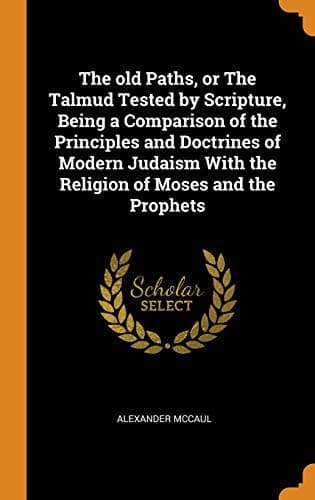
The old paths, or the Talmud tested by Scripture: Being a comparison of the principles and doctrines of modern Judaism with the religion of Moses and the prophetsMcCaul, Alexander
Religion
The old paths, or the Talmud tested by Scripture: Being a comparison of the principles and doctrines of modern Judaism with the religion of Moses and the prophets
McCaul, Alexander
Judaism -- Works to 1900
the Rabbies whose learning and genius were so marvellous. There is no
intimation that God gave the members of the Sanhedrin this knowledge,
which far exceeds the power or the life of man to attain by ordinary
means. No, all the glory of these marvellous acquirements is ascribed to
man alone. This forms a striking contrast to a narrative recorded in the
New Testament. We are there told that on a certain occasion the
disciples of Jesus of Nazareth addressed in their own language,
“Parthians, and Medes, and Elamites, and the dwellers in Mesopotamia,
and in Judea and Cappadocia, in Pontus and Asia, Phrygia, and Pamphylia,
in Egypt, and in the ports of Lybia about Cyrene, and strangers of Rome,
Jews and proselytes, Cretes and Arabians,” that is, the inhabitants of
sixteen countries. Now, the small number here stated is a presumptive
evidence of the truth of the fact. If an impostor, a Rabbinist who
wished to make a good story, had written this account, he would, beyond
all doubt, instead of sixteen, have specified all the seventy languages.
To his countrymen, who believed in the acquirements of the Sanhedrin,
this would have appeared no wise incredible. Indeed, if a man of that
time had wished to invent a miracle, the number seventy would have been
absolutely necessary for his purpose. For if every member of the
Sanhedrin could speak seventy languages, to say that other men spoke
sixteen would have been no miracle at all. The small number, therefore,
here given, shows that the authors of the narrative had no wish to
invent a miracle, but to state the sober truth. But then consider the
entire absence of vain-glory. The praise and the power of speaking even
this small number of languages is given altogether to God. The men were
Galileans, and had not acquired this by their own labour and genius.
“They were all filled with the Holy Ghost, and began to speak with other
tongues, as the Spirit gave them utterance.” (Acts ii. 1-11.) Here then
is a striking difference between the narratives of the Talmud and those
of the New Testament. The former exalts men. The latter gives glory to
God.
No. XXIII.
ASTROLOGY.
Public-domain text, read in full here on John Shaqi.
Reviews
Reviews
No reviews yet
Be the first to share your thoughts on this work.
Elsewhere in the archive
Join the Discussion
Join the discussion
Sign in to leave a comment or review.
Sign InorCreate an account