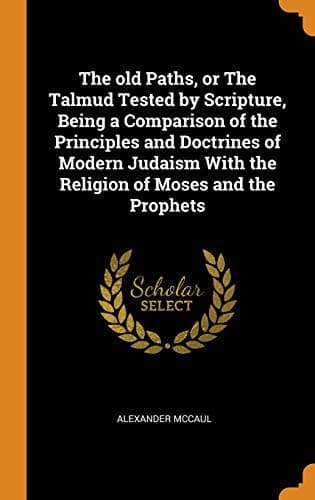
The old paths, or the Talmud tested by Scripture: Being a comparison of the principles and doctrines of modern Judaism with the religion of Moses and the prophetsMcCaul, Alexander
Religion
The old paths, or the Talmud tested by Scripture: Being a comparison of the principles and doctrines of modern Judaism with the religion of Moses and the prophets
McCaul, Alexander
Judaism -- Works to 1900
“It is not lawful to go out in an amulet, which is not approved, but if
it be approved, it is lawful. Whether it be the man or the amulet, which
is approved, makes no difference; for instance, if a man have written
one and the same charm in three copies, and all three have affected a
cure, the man is approved with respect to that charm every time that he
writes it, but not with respect to other charms; neither is the amulet
approved if written by another. There is also no difference in the case,
when the amulet is approved but the man not so; for instance, if a man
write one charm, and only one copy, and has with it effected a cure
three times, then that copy is approved for every man. A third case is,
when both the man and the amulet are approved; for instance, if a man
write one charm in three copies, and each has been of use to three men
or to one man three times, then the man is approved with respect to this
charm in every copy which he may write, and these copies are considered
as approved for the use of all men. But if he have written three
different amulets for one man, and have cured him three times, then
neither the man nor the amulet is approved. Further, it is lawful to go
out with an approved amulet, whether it be a writing or one made of
roots, and whether the man be dangerously ill or not. Neither is it
necessary that he should have been already epileptic, and now makes use
of it for a cure. On the contrary, if he be of an epileptic family, and
wear it as a preventive, it is lawful.” (Orach Chaiim. sec. 301.) There
can be no mistake here. This is Jewish law binding upon all who
acknowledge tradition. Neither is it a doubtful or passing notice; on
the contrary, the different cases are all enumerated, and every
particular specified. The oral law here gives the most unqualified
sanction to the use of amulets or charms, and that even on the
Sabbath-day. That such charms are near akin to magic or witchcraft is
plain from the nature and purpose of the manufacture, and from the
undisguised use of the word לחש “charms;” but there is a passage in
Rashi’s commentary on another Talmudic treatise, which puts this beyond
all doubt; we therefore give both the text and the commentary—
תנו רבנן שמונים תלמידים היו להלל הזקן שלשים מהן ראוים שתשרה עליהם שכינה
כמשה רבינו שלשים מהם ראוים שתעמוד להם חמה כיהושע בן נון עשרים בינוניים
בדול שבכולן יונתן בן עוזיאל קטן שבכולן ר׳ יוחנן בן זכאי אמרו עליו על ר׳
יוחנן בן זכאי שלא הניח מקרא משנה גמרא הלכות והגדות דקדוקי תורה ודקדודי
סופרים וקלין וחמורין וגזרות שוות ותקופות וגמטריאות ומשלות כובסים ומשלות
שועלים שיחת שדים ושיחת דקלים מלאכי שרת וכו׳ ׃
Public-domain text, read in full here on John Shaqi.
Reviews
Reviews
No reviews yet
Be the first to share your thoughts on this work.
Elsewhere in the archive
Join the Discussion
Join the discussion
Sign in to leave a comment or review.
Sign InorCreate an account