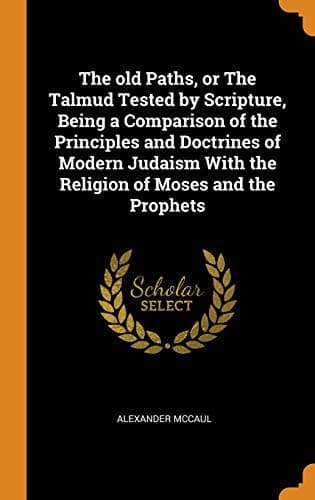
The old paths, or the Talmud tested by Scripture: Being a comparison of the principles and doctrines of modern Judaism with the religion of Moses and the prophetsMcCaul, Alexander
Religion
The old paths, or the Talmud tested by Scripture: Being a comparison of the principles and doctrines of modern Judaism with the religion of Moses and the prophets
McCaul, Alexander
Judaism -- Works to 1900
rejected, is entirely free from such deformities? Something has been
decidedly wrong, or the chosen people of God could not have remained so
long in captivity, unheeded and unhelped by the Holy One of Israel. An
exhibition of the doctrines of the oral law explains the cause. Israel
has departed from the religion of Moses, and pertinaciously adhered to a
system compounded of human inventions, and idolatrous heathenism. They
call Moses their master, and say that the oral law is derived from him,
but if we may from the work, form a conjecture about the author, it is
much more probably a tradition from the magicians of Egypt or the witch
of Endor. And if it had been handed down as such—if the Israelites had
presented the Talmud to the world and their posterity as part of the
heavy yoke of Egypt, we should not have been astonished at the
universality of its reception. But that Israel should ever have been so
far imposed upon, as to believe that Moses or the prophets ever had
anything to do with the oral law appears almost inexplicable. However
unwilling one may be to apply to fellow-sinners any prophecy that
contains a denunciation of God’s wrath, one cannot help asking, was it
of this that the prophet said, “The Lord hath poured out upon you the
spirit of deep sleep, and hath closed your eyes; the prophets and your
rulers the seers hath he covered. And the vision of all is become unto
you as the words of a book that is sealed, which men deliver to one that
is learned, saying, read this, I pray thee; and he saith, I cannot, for
it is sealed: and the book is delivered to him that is not learned,
saying, Read this, I pray thee, and he saith, I am not learned.” (Isaiah
xxix. 10-12.) This question is, however, far more important to Israel
than to us, and to them we leave the answer. Some will still persist in
the assertion that this heathenish compound is the highest wisdom. The
great majority of the nation is devoted to the Talmud, which is still
the cistern whence the synagogues endeavour to draw the waters of life.
The multitude does it in ignorance, they are, therefore, not so
culpable. But there are many that know better, what then is the reason
that they do not strain every nerve to deliver their brethren? These few
do not suffer the oral law to interfere either with their business or
their convenience. They profane the Sabbath, eat Gentile food, carry on
their business on feasts and festivals. If they do all this on
principle, why not protest against error? Is it because they are
indifferent to the welfare of their brethren? If indifference be the
only fruit of this intellectual progress, instead of rising above, they
have sunk below superstition itself.
Footnote 23:
The only explanation which Rashi gives of these words is לחש הוא “It
is a charm.”
Footnote 24:
Literally, לחש הוא “It is a charm.”—Rashi.
Footnote 25:
The Bareitha.
No. XXVI.
CHARMS CONTINUED.
Public-domain text, read in full here on John Shaqi.
Reviews
Reviews
No reviews yet
Be the first to share your thoughts on this work.
Elsewhere in the archive
Join the Discussion
Join the discussion
Sign in to leave a comment or review.
Sign InorCreate an account