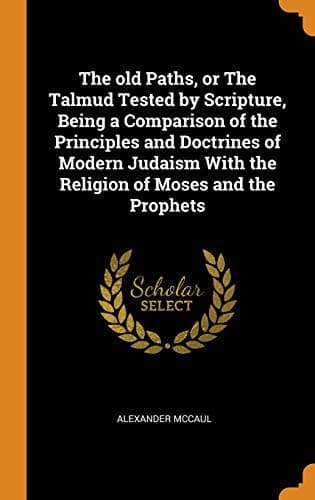
The old paths, or the Talmud tested by Scripture: Being a comparison of the principles and doctrines of modern Judaism with the religion of Moses and the prophetsMcCaul, Alexander
Religion
The old paths, or the Talmud tested by Scripture: Being a comparison of the principles and doctrines of modern Judaism with the religion of Moses and the prophets
McCaul, Alexander
Judaism -- Works to 1900
The Rabbinic Jews comfort themselves with the idea, that they cannot
have this world and the world to come too; but they confound two things
which are perfectly distinct, God’s mode of dealing with individuals,
and his mode of dealing with nations. Individuals have not only an
existence in time, but for eternity. Worldly misfortune to an individual
is, therefore, no proof of God’s displeasure, because the world is only
a part, and that the smallest part, of his existence. But the case of
nations is different. They exist only in time, and therefore the rewards
and punishments must be temporal, and so God has uniformly promised to
the Jewish people temporal prosperity, in case of national obedience,
and temporal calamity in the former case. Whenever, therefore, we see
Israel exiled from their land and scattered among the nations, we must
infer, if Moses has spoken the truth, that it is because they have
departed from the God of their fathers.
Footnote 26:
Such as a key, a ring, or a knife.—Rashi.
No. XXVII.
SABBATIC LAWS.
How little the oral law has hitherto done to promote the peace and
happiness of Israel, we considered in our last number. It may, however,
be replied, that it has not had a fair trial, and that the failure is to
be attributed rather to the people than to the law. This possible reply
naturally leads us to think, what then would be the state of Israel and
of the world at large, if the oral law were universally and exactly
observed, and its disciples had supreme dominion in the world? Suppose
that all the kingdoms of the world were melted into one vast and
universal monarchy, and the sceptre swayed by a devout and learned
rabbi, and all the magisterial offices filled by able and zealous
Talmudists, would the world be happy? This is a fair question, and well
deserves consideration, for there can be no doubt that true religion was
intended by its Divine Author to promote the happiness of his
creatures:—
דוכיה דרכי נועם וכל נתיבוביה שלום ׃
“Her ways are ways of pleasantness, and all her paths are peace.” (Prov.
iii. 17.) And that not of a few, but of all without exception.
הלא אב אחד לכלנו , הלא אל אחד בראנו ׃
Public-domain text, read in full here on John Shaqi.
Reviews
Reviews
No reviews yet
Be the first to share your thoughts on this work.
Elsewhere in the archive
Join the Discussion
Join the discussion
Sign in to leave a comment or review.
Sign InorCreate an account