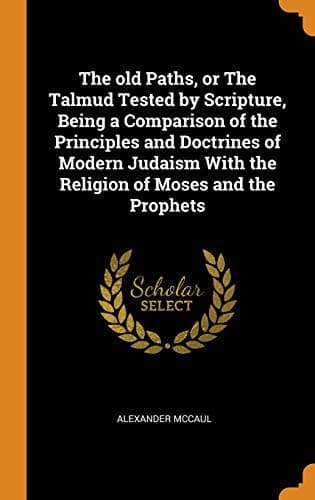
The old paths, or the Talmud tested by Scripture: Being a comparison of the principles and doctrines of modern Judaism with the religion of Moses and the prophetsMcCaul, Alexander
Religion
The old paths, or the Talmud tested by Scripture: Being a comparison of the principles and doctrines of modern Judaism with the religion of Moses and the prophets
McCaul, Alexander
Judaism -- Works to 1900
“Have we not all one father? Hath not one God created us?” (Mal. ii.
10.) That religion, therefore, cannot be of God, which would make the
greatest portion of his creatures miserable, and confer happiness on a
very limited number. The religion that came from heaven, wherever it
exists, must contain the elements of happiness for all nations, and
include all the families of man. It must exclude none but the wilfully
and obstinately wicked, who carry the torments of hell in their own
bosom, and would be necessarily unhappy even in heaven itself. A
religion, whose principles, if triumphant, would effect so desirable a
consummation, must be true. The question is, whether modern Judaism, if
it had full and free scope for the realization of all its principles,
would bear such blessed fruit? Our late inquiries about amulets and
magic led us to consider some of the laws about the Sabbath-day, and as
when true religion prevails, this ought to be the happiest day of the
week, the laws respecting it shall furnish materials for our answer.
That a rabbinical Sabbath would be the happiest day in the week we much
doubt, for, in the first place, to keep the rabbinical Sabbath aright,
it is necessary to be perfectly acquainted with all the laws relating to
it, which are very many and very intricate, occupying even in Rambam’s
compendium, including the notes, above one hundred and seventy folio
pages.[27] That any conscientious man can be happy with such a load of
law about his neck appears impossible. He must be in continual fear and
trembling lest he should through forgetfulness or inadvertence be guilty
of transgression, and the continued watchfulness and anxiety would be
more intolerable than the hardest labour. But if Rabbinism wielded the
supreme power, he would have to dread the most severe and immediate
punishment:—
שביתה בשביעי ממלאכה מצות עשה שנאמר וביום השביעי תשבות , וכל העושה בו
מלאכה ביטל מצות עשה ועבר על לא תעשה שנאמר לא תעשה כל מלאכה , ומהו חייב
על עשיית מלאכה אם עשה ברצונו בזדון חייב כרת ואם היה שם עדים והתראה נסקל
ואם עשה בשגגה חייב קרבן הטאת קבועה ׃
Public-domain text, read in full here on John Shaqi.
Reviews
Reviews
No reviews yet
Be the first to share your thoughts on this work.
Elsewhere in the archive
Join the Discussion
Join the discussion
Sign in to leave a comment or review.
Sign InorCreate an account