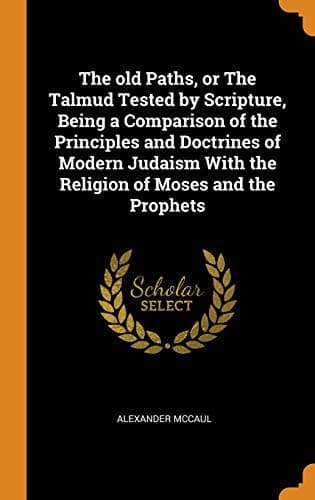
The old paths, or the Talmud tested by Scripture: Being a comparison of the principles and doctrines of modern Judaism with the religion of Moses and the prophetsMcCaul, Alexander
Religion
The old paths, or the Talmud tested by Scripture: Being a comparison of the principles and doctrines of modern Judaism with the religion of Moses and the prophets
McCaul, Alexander
Judaism -- Works to 1900
“A Gentile woman is not to be delivered upon the Sabbath, not even for
payment, neither is the enmity to be regarded. It is not to be done,
even though no profanation of the Sabbath should be implied. But the
daughter of a sojourning proselyte may be delivered, for we are
commanded to preserve the life of such, but the Sabbath is not to be
profaned on her account.” (Ibid. chap. ii. 12.) We ask every Jew who has
got the heart of a man, whether such a law can be from God? or whether
the religion of which it forms a part can be true? A poor woman, in the
hour of her extremity, is to be left to her fate, simply because she is
an idolatress. The mother and the child are both to be left to perish,
because, either through her own fault, or through the circumstances of
her birth, she has remained ignorant of the true God. But grant, for the
sake of argument, that the mother is so hardened a sinner as to be
beyond the mercies of sinful men, what has the child done, that its life
is to be given as a sport to chance? Is that the way to convert a sinner
from the error of her ways, or to recommend the true religion? The most
besotted of idolaters, who believes at all in a Divine and merciful
being, would pronounce such religion false. A few such cases would soon
spread through the world, and Judaism become the aversion of every heart
that can sympathize with suffering. And thus, if true, it would confirm
all mankind in error. But it cannot be: the religion that comes from God
bears the impress of its author, and teaches such love and kindness that
the practice of it softens, where it does not convert. Its bitterest
enemies must confess that its practical principles are worthy of all
admiration. But there is here a second case, the daughter of a
sojourning proselyte, towards whom the oral law is a little more
lenient, it allows such an one to be delivered, but does not permit the
Sabbath to be profaned on her account. Suppose then that such an one
found herself in the midst of Jews, and after her delivery required the
comfort of a fire or warm food for herself or her infant, or any other
assistance that would imply a breach of the Sabbath, it could not be
done, but for an Israelitess it may be done; can this proceed from Him
who seeks the happiness of all his creatures? It cannot be said that
this is a rare case, for it is easy to show that this is the general
spirit of the oral law:—
היתה חצר שיש בה גוים וישראלים אפילו ישראל אחד ואלף גוים ונפלה עליהם
מפולת מפקחין על הכל מפני ישראל , פירש אחד מהם לחצר אחרת ונפלה אליו אותו
חצר מפקהין עליו שמא זה שפירש היה ישראל והנשארים גוים , נעקרו כולן מחצר
זו לילך לחצר אחרת ובעת עקירתן פירש אחד מהם ונכנס לחצר אחרת ונפלה עליו
מפולת ואין ידוע מי הוא אין מפקחין עליו , שכיון שנעקרו כולם אין כאן ישראל
, וכל הפורש מהן כשהן מהלכין הרי הוא בחזקת שפירש מן הרוב ׃
Public-domain text, read in full here on John Shaqi.
Reviews
Reviews
No reviews yet
Be the first to share your thoughts on this work.
Elsewhere in the archive
Join the Discussion
Join the discussion
Sign in to leave a comment or review.
Sign InorCreate an account