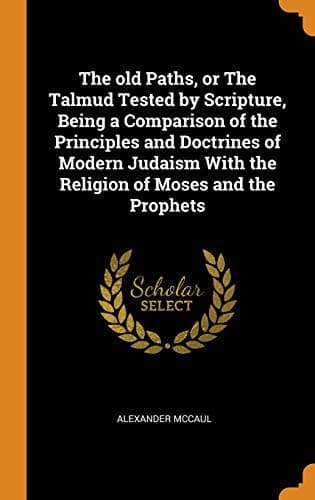
The old paths, or the Talmud tested by Scripture: Being a comparison of the principles and doctrines of modern Judaism with the religion of Moses and the prophetsMcCaul, Alexander
Religion
The old paths, or the Talmud tested by Scripture: Being a comparison of the principles and doctrines of modern Judaism with the religion of Moses and the prophets
McCaul, Alexander
Judaism -- Works to 1900
“If Gentiles and Israelites live together in one court, even if there be
only one Israelite and a thousand Gentiles, and a ruin fall on one of
them, the rubbish is to be cleared away, on account of the Israelite. If
one of them had gone by himself to another court, and that court fell
upon him, the rubbish is also to be cleared away, for perhaps this one
was the Israelite, and the rest were Gentiles. But if they all set out
to go from this court to another court, and during the time of their
moving, one of them separated and went to another court, and a ruin fell
upon him, and it is not known who he is, the rubbish is not to be
cleared away. For as they all moved together, it is certain that the
Israelite was not amongst them; and every one who separated from them,
whilst going, is to be reckoned as belonging to the majority.” (Ibid.
20, 21.) Here the same utter recklessness of Gentile life or comfort is
displayed, and no one will pretend that such laws, if carried into
effect, would promote the happiness of mankind. Accidents, like births,
happen on the Jewish Sabbath as well as on the other days, but if the
oral law had power, the Gentiles to whom any accident happened, might
wait until the Sabbath was over, and must thus lose the only comfort
which is possible on such an occasion. When a man is suffering from
severe bodily injury, there are but two sources of consolation; the one
is the kind and benevolent attentions of man, the other the remembrance
of God’s mercy and goodness, but the oral law cuts off both from the
suffering Gentile. It forbids its disciples to help him, and says at the
same time that this is the law of God. But could the Jews themselves be
happy on that Sabbath, where such an accident occurred, and where they
had left a poor Gentile buried under the ruins of a building? Could they
enjoy peace in the bosom of their family, or could they find holy
pleasure in the prayers of the synagogue when they had left one of God’s
creatures, a fellow-man, to perish in his misery? But this law would
affect more than the individual sufferer, and the few surrounding
spectators. It would prevent all brotherly love between Jews and
Gentiles, and until all men learn the reality of charity, the world
cannot be happy. If it be true that the religion given by God, wherever
it is carried into practice, makes men happy, then the religion of the
oral law cannot be true, for, if practised, it would make, all men
miserable.
Footnote 27:
Hilchoth Shabbath and Hilchoth Eruvin extend from fol. 140 to fol.
226.
No. XXVIII.
FAST FOR THE DESTRUCTION OF THE TEMPLE.
Public-domain text, read in full here on John Shaqi.
Reviews
Reviews
No reviews yet
Be the first to share your thoughts on this work.
Elsewhere in the archive
Join the Discussion
Join the discussion
Sign in to leave a comment or review.
Sign InorCreate an account