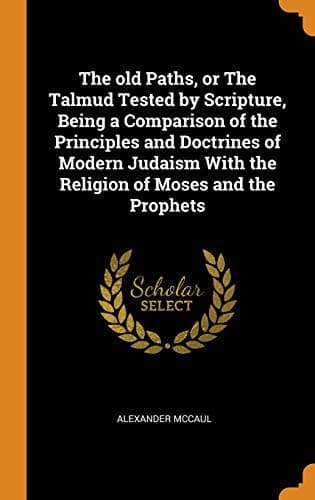
The old paths, or the Talmud tested by Scripture: Being a comparison of the principles and doctrines of modern Judaism with the religion of Moses and the prophetsMcCaul, Alexander
Religion
The old paths, or the Talmud tested by Scripture: Being a comparison of the principles and doctrines of modern Judaism with the religion of Moses and the prophets
McCaul, Alexander
Judaism -- Works to 1900
If Judaism, therefore, should ever attain the supreme power,
the working and unlearned classes will be placed in the power and at the
mercy of the learned, and every disciple of a wise man will wield the
absolute power of an autocrat.
But some one may say, that if the disciple of a wise man should
excommunicate any one hastily that the people would not regard his
excommunication. But if they did not, they would do it at their peril,
for the oral law expressly declares that they are bound to observe the
excommunication not only of a rabbi, but of one of his disciples:—
הרב שנידה לכבודו כל תלמידיו חייבין לנהוג בו נדוי במנודה אבל תלמיד שנידה
לכבוד עצמו אין הרב חייב לנהוג בו נדוי אבל כל העם חייבין לנהוג בו נדוי ׃
“When a rabbi excommunicates on account of his honour, all his disciples
are bound to treat the excommunicate person as such. But when a disciple
excommunicates on account of his own honour, the rabbi is not bound to
treat that person as excommunicate, but all the people are bound.”
(Ibid. c. vi. 13.) Nothing can more clearly prove the injustice of such
excommunication. If the rabbi be not bound to regard the disciples’
excommunication, why should all the people be bound? If the offence
committed against the disciple be a sin before God, and such it ought to
be to require such severe punishment, the excommunication ought to be as
binding upon the rabbi as upon the people. But if it be not binding upon
the rabbi, then the offence for which it was inflicted cannot be a sin
in the sight of God, it is therefore an arbitrary and unjust punishment,
and it is both wicked and cruel to require the people to obey it. But
the principle itself is monstrous, that the disciple of a rabbi should
be constituted both judge and jury in his own case, and have the power
of lording it over those, whose circumstances do not permit them to
devote their time to study, and who, therefore, cannot be enrolled in
the privileged class. Just suppose that the clergy of this land, or the
professors and students at our Universities, were to claim such power,
and to excommunicate and anathematize all who treated them with
disrespect, and that without any trial or conviction before a legal
tribunal, and that the unfortunate victims were to be separated from
society, ruined, and then their dead bodies treated with dishonour,
would not this be regarded as a monstrous and insupportable tyranny? Yet
this is what the oral law claims for the rabbies and their disciples,
and what they would possess and exercise if Judaism ever attains to
supreme power. Would the Jews wish such a power established? Do they
desire to live under such a government? If they do not, if they prefer
the personal liberty and the even-handed justice secured to them by
Christian laws, then they confess that the Christian principles are
better than those of their own religion, and they must be charged with
inconsistency in professing and asserting the truth of a religion, which
they hope may never triumph.
Public-domain text, read in full here on John Shaqi.
Reviews
Reviews
No reviews yet
Be the first to share your thoughts on this work.
Elsewhere in the archive
Join the Discussion
Join the discussion
Sign in to leave a comment or review.
Sign InorCreate an account