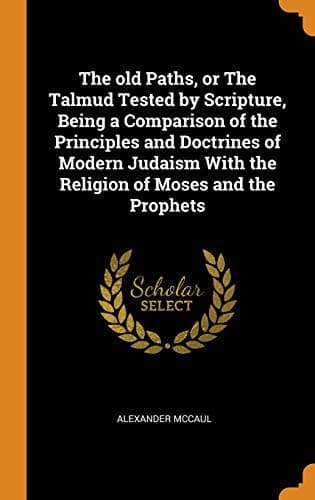
The old paths, or the Talmud tested by Scripture: Being a comparison of the principles and doctrines of modern Judaism with the religion of Moses and the prophetsMcCaul, Alexander
Religion
The old paths, or the Talmud tested by Scripture: Being a comparison of the principles and doctrines of modern Judaism with the religion of Moses and the prophets
McCaul, Alexander
Judaism -- Works to 1900
“If a man sin one sin, he gives the preponderance for himself and for
all the world to the scale of guilt, and causes destruction. But if he
perform one commandment, he gives the preponderance both for himself and
all the world to the scale of merit, and causes salvation and
deliverance to himself and them, as it is said, ‘The righteous is the
foundation of the world’ (Prov. x. 25), which means that righteousness
gives the world a preponderance in the scale of merit and delivers it.
And on this account all the house of Israel are accustomed to abound in
almsgiving, and in good deeds, and to be diligent in the commandments in
the interval between New Years Day and the Day of Atonement more than in
all the year besides.” (Ibid. 4.) This then is the doctrine which we
have to consider.
The first great principle is that “Every one of the children of men has
merits and has sins.” That every man has sins we readily admit; but that
any man, or any angel, or any of God’s creatures, has any merit in the
sight of God we deny. First, because the idea of merit is utterly
inconsistent with the idea of the relation in which the creature stands
to the Creator. Every created being is bound by the very fact of his
creation to love God with all his heart and soul, and mind and strength,
and to do all his will. Whatsoever, therefore, he does, he can never
exceed the limit of his bounden duty, and can therefore never lay any
claim to merit. If created beings were free from all obligation to love
God or to do his will—if they were independent and masters of
themselves, then by loving God or doing his will they might have merit,
for they would be doing him a service which He has no right to require.
Just as a man that is free may hire himself to do work for another man,
which he is not bound to do, and thereby earn wages. But not so the
slave, who is his maker’s property. He can only do his duty, and if he
toil all the day and be diligent and faithful in his master’s service,
he still can lay no claim to wages or to merit; he has only done what he
is bound to do. To lay any claim to merit, we must stand on equal terms,
and confer what the other has no right to expect. But this no created
being can ever do. He is a debtor overwhelmed with such an amount of
debt, that all that he has or can raise only goes in part payment, and
who therefore will never be able to confer anything which is not already
due. And therefore it is said, “Can a man be profitable unto God?” and
again, “Is it gain to him, that thou makest thy ways perfect?” (Job
xxii. 2, 3.) The unfallen angels themselves have no merit before God,
and much less fallen and rebellious man.
Public-domain text, read in full here on John Shaqi.
Reviews
Reviews
No reviews yet
Be the first to share your thoughts on this work.
Elsewhere in the archive
Join the Discussion
Join the discussion
Sign in to leave a comment or review.
Sign InorCreate an account