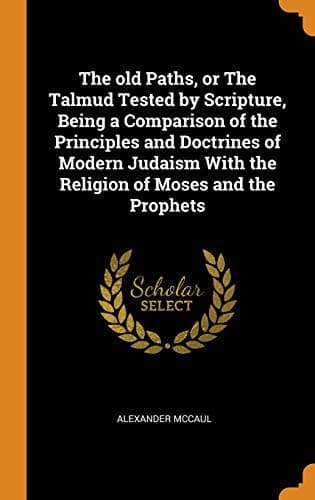
The old paths, or the Talmud tested by Scripture: Being a comparison of the principles and doctrines of modern Judaism with the religion of Moses and the prophetsMcCaul, Alexander
Religion
The old paths, or the Talmud tested by Scripture: Being a comparison of the principles and doctrines of modern Judaism with the religion of Moses and the prophets
McCaul, Alexander
Judaism -- Works to 1900
The next assertion of the oral law is, that “If a man’s merits exceed
his sins, he is righteous.” This pre-supposes, first, that a man’s
merits may exceed his sins; and asserts, secondly, that in this case he
is accounted righteous. But where is the man whose “merits exceed his
sins?” Where is the man who keeps any one of God’s commandments
perfectly? In all our best deeds and efforts there is sin of admixture
or of imperfection. Often, when by the help of God, a good thought or an
honest intention is conceived in the heart, before it can be realized in
action, some selfish and unworthy motive associates itself with it, and
spoils the whole. And in every case the obedience is imperfect, so that
all our best acts become occasions of committing sins either of
infirmity or imperfection, and thus our sins are certainly as many as
our good deeds, for each one of them has a sin as its associate. But how
many are our sins of thought, word, and deed, which are mere sins
without any admixture of good, and which in themselves are “more than
the hairs of our head?” And even if we should admit that the final
result depends not upon number, but upon magnitude, then there is one
sin that extends from the moment of our birth to the latest hour of our
existence, and that is, want of perfect love to God. This he requires at
every moment, but yet how many hours of every day do we pursue our
business or our pleasures without a single remembrance of him? And how
few, how hasty, and how interrupted are our grateful recollections of
the love and mercy of God! Here then is a sin which in magnitude far
exceeds the aggregate of all our gratitude and all our services, and
which in itself would sink the scale of guilt down to the lowest hell.
But by the side of it there is another equally immense, and that is our
continued transgression of the commandment, “Thou shalt love thy
neighbour as thyself.” The very best of all God’s saints makes, at the
most, but a feeble struggle against the love of self. He admits the
extent of his duty to his neighbour, he knows it—he desires to fulfil
it. He watches against himself, and yet with all his care, self-love
creeps in again and again, and asserts the mastery over his thoughts and
actions. These two sins would outweigh a thousand times all the six
hundred and eleven remaining commandments of which Israel boasts, even
if they kept them all without a single transgression or a shade of
imperfection. With these two sins on our consciences, it is perfectly
absurd to talk of our merits exceeding our sins. There is not, and never
was in the world, a mere child of Adam, whose sins did not for exceed
his good deeds. If, therefore, it be necessary, in order to be accounted
just, that our merits should exceed our sins, we must give up all hope
of being justified before God.
Public-domain text, read in full here on John Shaqi.
Reviews
Reviews
No reviews yet
Be the first to share your thoughts on this work.
Elsewhere in the archive
Join the Discussion
Join the discussion
Sign in to leave a comment or review.
Sign InorCreate an account