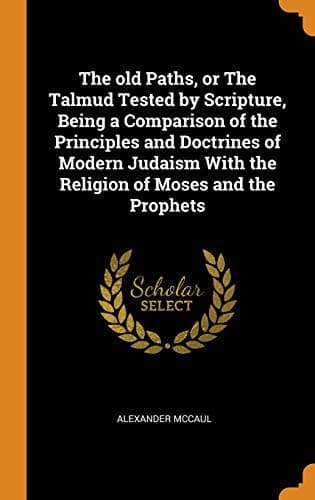
The old paths, or the Talmud tested by Scripture: Being a comparison of the principles and doctrines of modern Judaism with the religion of Moses and the prophetsMcCaul, Alexander
Religion
The old paths, or the Talmud tested by Scripture: Being a comparison of the principles and doctrines of modern Judaism with the religion of Moses and the prophets
McCaul, Alexander
Judaism -- Works to 1900
Every Jew who attends the worship of the synagogue is responsible in his
station and calling, for the error and falsehood which its prayers
propagate amongst the people. But at all events every person who
disbelieves this story of the angels carrying up the sounding of the
cornet, must grant that a system teaching such a method of salvation is
very unsafe; and that, as it grossly errs in this one article it is
suspicious in all. But besides the absurdity of this doctrine, we must
notice its inconsistency. The Prayer-book states that the blowing of the
cornet is necessary to the procuring of pardon; it therefore implies
that pardon is necessary, and therefore that Israel is guilty; what,
then, becomes of merits? If Israel can be justified by merits, the
blowing of the cornet is superfluous; for, in that case, all they want
is justice. Where a man can claim salvation because of all his good
deeds, he need not fear the attribute of righteousness, מדת הדין, and
does not want the attribute of mercy. But the moment that he
acknowledges his need of forgiveness, he confesses that he has no
merits. If, therefore, the Prayer-book be right in acknowledging sin and
praying for pardon, the oral law is wrong in teaching justification by
merits. One contradicts the other, and therefore they cannot both be
from God; and the man who believes both is guilty of renouncing his
reason. But the man who trusts his salvation to a system so inconsistent
with itself, is utterly devoid of wisdom. He is hazarding his eternal
welfare on the testimony of a witness who contradicts himself; who says
at one time, that a man can be saved by his merits, and at another time
that he has no merits that can stand the scrutiny of God’s righteous
judgment.
No. XXXV.
JUSTIFICATION.
Public-domain text, read in full here on John Shaqi.
Reviews
Reviews
No reviews yet
Be the first to share your thoughts on this work.
Elsewhere in the archive
Join the Discussion
Join the discussion
Sign in to leave a comment or review.
Sign InorCreate an account